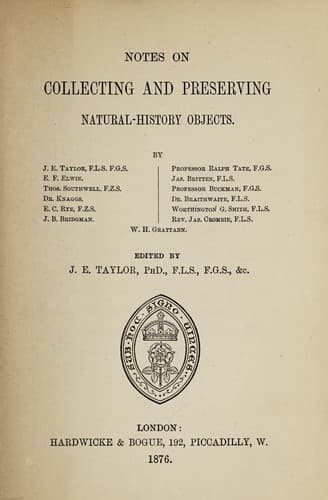
Notes on Collecting and Preserving Natural-History Objects
Science
Notes on Collecting and Preserving Natural-History Objects
Botanical specimens -- Collection and preservation; Zoological specimens -- Collection and preservation
Secondly, as to the student's comforts and necessaries. These are
generally the last thing an ardent naturalist thinks about. For
ourselves, however, we give him ample leave to provide himself with
pipe and tobacco, should his tastes lie in that direction. _We_ never
enjoyed a pipe half so much as when solitarily disinterring organic
remains which had slumbered in the heart of the rock for myriads of
ages. As to the _beer_, we can vouch that it never tastes anything like
so good as during a geological excursion.
We have found the leathern bags sold for school-book purposes to be
as handy to deposit specimens in, during a journey, as anything else.
They have the merit of being cheap, are strong, and easily carried. If
not large enough, then get a strong, coarse linen haversack, like that
worn by volunteers on a field day. Paper, cotton _wadding_ (not wool),
sawdust for fragments of larger fossils, intended to be repaired
at home, wooden pill-boxes, and a few boxes, which may be obtained
from any practical naturalist, with _glass tops_, are sufficient
"stock-in-trade" for the young geologist. The wadding does not adhere
to the specimens as wool does, and the glass-topped boxes are useful,
as it is not then necessary to open a box and disinter a delicate
fossil from its matrix in order to look at it. Add a good strong pocket
lens, such as may be bought for half-a-crown, and your equipment will
be complete. If you intend to study any particular district, get the
sheets published by the Geological Survey. These will give you, on a
large scale, the minute geology of the neighbourhood, the succession
of rocks, faults, outcrops, &c. In fact, you may save yourself a world
of trouble by thus preparing yourself a week or so before you make
your geological excursion. The pith of these remarks applies with
equal force if you purpose, first of all, to examine the neighbourhood
in which you live. Don't do so until you have read all that has been
written about it, and examined all the available maps and sections.
This advice however, applies more particularly to _geological_
examination of strata. If you are bent chiefly on _palæontological_
investigation, that is, on the study of _fossils_, perhaps it will be
best just to read any published remarks you may have access to, and
then boldly take the field for yourself. In addition to a hammer, we
would advise the young student to take a good narrow-pointed steel
chisel, and a putty-knife. The former is very useful for working round,
and eventually obtaining, any fossil that may have been weathered into
relief. The latter is equally serviceable for clayey rocks or shales.
Public-domain text, read in full here on John Shaqi.
Reviews
Reviews
No reviews yet
Be the first to share your thoughts on this work.
Join the Discussion
Join the discussion
Sign in to leave a comment or review.
Sign InorCreate an account