Notes on Collecting and Preserving Natural-History Objects — John Shaqi
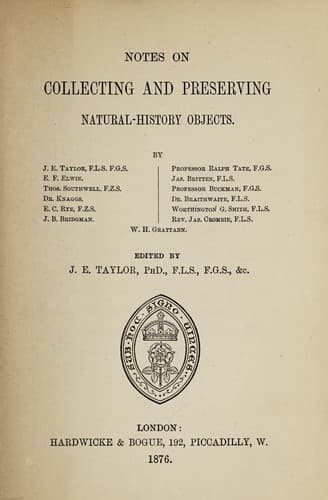
Notes on Collecting and Preserving Natural-History Objects
Science
Notes on Collecting and Preserving Natural-History Objects
Botanical specimens -- Collection and preservation; Zoological specimens -- Collection and preservation
In arranging the spoils of these excursions for the cabinet, a little
care and taste are required. We will suppose you to possess one of
those many-drawered cabinets which can now be obtained so cheaply.
Begin at the bottom, so that the lowest drawers represent the
lowest-seated and oldest rocks, and the uppermost the most recent. If
possible, have an _additional_ cabinet for _local_ geology, and never
forget that the first duty of a collector is to have his own district
well represented! A compass of a few miles will, in most cases,
enable him to get a store of fossils or minerals which cannot well be
obtained elsewhere. Supposing he is desirous of having the geological
systems well represented, he can always do so by the insertion of such
paragraphs as those which appear in the Exchange columns of 'Science
Gossip.' It is by well and thoroughly working separate localities in
this fashion that the science of geology is best advanced. You hear
a good deal about the "missing links," and it is an accepted fact
that we, perhaps, do not know a tithe of the organic remains that
formerly enjoyed life. Who knows, therefore, but that if you exhaust
your district by the assiduous collection of fossils, you may not come
across such new forms as may settle many moot points in ancient and
modern natural history? The genuine love of geological study is always
pretty fairly manifested in a student's cabinet. Science, like charity,
begins at home. It impels a man to seek and explain that which is
nearest to him, before he attempts the elucidation of what really lies
in another man's territory!
It is not necessary that the student should waste time in the field
about naming or trying to remember the names of fossils, &c., on the
spot. That can be best done at home, and the pleasure of "collecting"
can thus be spun to its longest length. Box them, pack them well (or
all your labour is lost), and name them at home. Or supposing you do
not possess books which can assist you in nomenclature, carry your
fossils or minerals, just as you found them, to the nearest and best
local museum, where you will be sure to see the majority of them in
their proper places and with their proper names. Copy these, and when
you arrange your specimens in the cabinet, either get printed cards
with the following headings--
_Genus______________________________________
_Species____________________________________
_Formation__________________________________
_Locality___________________________________
Public-domain text, read in full here on John Shaqi.
Reviews
Reviews
No reviews yet
Be the first to share your thoughts on this work.
Join the Discussion
Join the discussion
Sign in to leave a comment or review.
Sign InorCreate an account