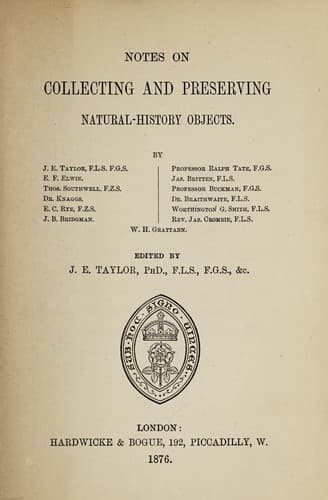
Notes on Collecting and Preserving Natural-History Objects
Science
Notes on Collecting and Preserving Natural-History Objects
Botanical specimens -- Collection and preservation; Zoological specimens -- Collection and preservation
We will assume that our collecting for the year has come to a close;
that the long evenings are beginning, and that our dried plants have
been brought together from their temporary resting-places to be revised
and selected from, so that they may be intercalated in their places in
the herbarium, if we already possess one, or, if we are as yet quite
novices, that they may form a nucleus around which the whole British
flora shall be gathered in due course. First of all, we must make all
necessary preparation for--
_Mounting_, the first essential to which is paper. Much of the neatness
of a herbarium depends upon its uniformity, so that it is desirable
to lay down a definite plan at the beginning and to act up to it
consistently. Amateurs often spoil specimens which they have collected
and preserved with considerable care by transferring them from one
sheet to another; from books--but it is only _very_ amateur botanists
who keep their plants in this way!--to loose sheets, from small paper
to large, and so on; each change being attended with some slight damage
to the specimen so treated. It is, I believe, the common practice on
the Continent to keep the specimens loose in folded sheets of paper;
but this plan is not followed in England, and although advantageous,
as permitting the fullest examination of the plant, it is attended
with much risk to the specimens in the way of breakage; so that we
may consider it settled that we are going to fasten our plant down
upon a sheet of paper. This must be rather stout, and large enough
to admit the full representation of the species. The sheets used at
the Kew Herbarium are 16-1/2 inches long by 10-1/3 inches wide; those
employed at the British Museum are 17-1/2 inches by 11-1/4 inches; but
the former will be found amply sufficient for our purpose. The next
consideration is the means by which the specimens are to be secured,
which are more various than might at first be supposed. Some persons
sew them to the paper; others place straps over them, which are secured
with small pins; but the choice practically lies between fixing the
whole specimen to the paper with gum, paste, or glue, or securing it
with straps of gummed paper. The former plan, which is that adopted at
our great public herbaria, is certainly better for specimens which
are likely to be much consulted; but the latter is in some respects
more satisfactory, if somewhat tedious, as it admits the removal of the
plant to another sheet if necessary, and delicate portions, such as
thin petals or leaves, are not injured as they are when gummed down. At
the British Museum and Kew a mixture of gum tragacanth and gum-arabic
(the former dissolved in the latter), in about equal parts, is used for
this purpose; but very coriaceous specimens are secured with glue at
the last-named establishment, while in the former the stems and ends
of branches are usually also secured with straps. When the specimen is
Public-domain text, read in full here on John Shaqi.
Reviews
Reviews
No reviews yet
Be the first to share your thoughts on this work.
Join the Discussion
Join the discussion
Sign in to leave a comment or review.
Sign InorCreate an account