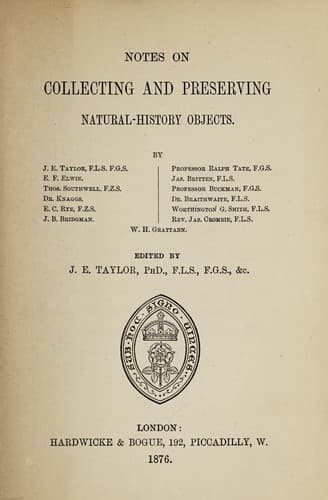
Notes on Collecting and Preserving Natural-History Objects
Science
Notes on Collecting and Preserving Natural-History Objects
Botanical specimens -- Collection and preservation; Zoological specimens -- Collection and preservation
entirely gummed down, it is a good plan to keep a few extra flowers or
fruits in a small capsule attached to the sheet: these will be useful
if it is required to dissect such portions, and the specimen need not
be injured for such purpose.
_Poisoning._--Some persons are in the habit of employing a solution of
corrosive sublimate for the purpose of washing over their plants when
mounted, and so preventing the development of animal life. The solution
in use at the Kew Herbarium is composed of one pound of corrosive
sublimate, and the same quantity of carbolic acid to four gallons of
methylated spirit; this fulfils the purpose for which it is intended
very well, but is somewhat disagreeable to use. At the British Museum
it is found that the presence of camphor, frequently renewed in each
cabinet, is sufficient to prevent the attacks of insects. It will soon
be discovered that some plants, such, for example, as the _Umbelliferæ_
and _Grossulariaceæ_, are peculiarly liable to such attacks; and these
orders must be inspected from time to time, so that any insect ravages
may at once be checked. Damp is to be avoided in the situation of the
herbarium, as it favours the development not only of insects but of
mould, and renders the specimens rotten.
The question of _labelling_ is of some importance, especially to those
who value neatness and uniformity in the appearance of their herbarium.
One or two sets of printed labels for this purpose have been issued,
but they cannot be recommended. They give more than is necessary, e.g.
the English, or, more correctly, the book-English names, the general
habitats, and definite localities of rare species, and allow very
insufficient space for filling in the date and place of collecting,
the name of the collector, and such remarks as occasionally occur.
The plan of writing all necessary information upon the sheet itself
is a good one; but those who prefer a uniform series of labels will
find that a form like the following is as useful as any which they can
adopt, and includes all necessary information. The size here given
will be adequate for almost all requirements, and is a "happy medium"
between the small tickets upon which we have animadverted, and the
enormous ones with which some botanists think it necessary to accompany
their specimens. Care should be taken to avoid the possibility of a
misplacement of labels; many serious blunders have arisen from the
neglect of due precaution in this matter.
Herb. John Smith.
Ranunculus acris, L.
& R. Steveni, Reich.
Loc. Meadows near Barchester.
Date, June 30, 1874.
Coll. John Smith.
Public-domain text, read in full here on John Shaqi.
Reviews
Reviews
No reviews yet
Be the first to share your thoughts on this work.
Join the Discussion
Join the discussion
Sign in to leave a comment or review.
Sign InorCreate an account