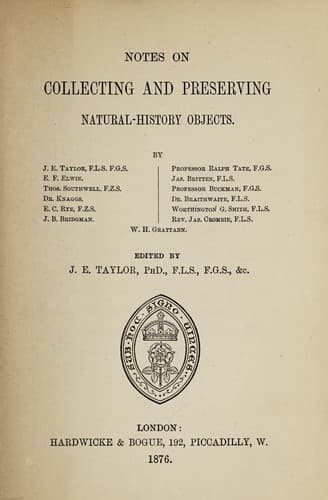
Notes on Collecting and Preserving Natural-History Objects — John Shaqi
Notes on Collecting and Preserving Natural-History Objects
Science
Notes on Collecting and Preserving Natural-History Objects
Botanical specimens -- Collection and preservation; Zoological specimens -- Collection and preservation
(which can always be obtained at a cheap rate from the London dealers),
or else set to work and copy them yourself in a good plain hand, so
that there is no mistaking what you write. As far as possible, in
each drawer or drawers representing a geological formation, arrange
your specimens in natural-history order--the lowest organisms first,
gradually ascending to the higher. By doing so, you present geological
and zoological relationship, so that they can be taken in at a glance.
You further make yourself acquainted with the relations of the fossils
in a way you never would have done, had you been content to huddle
them together in any fashion, so that you had them all together.
Glass-topped boxes, again, are very useful in the cabinet, especially
for delicate or fragile fossils, as people are so ready to take them in
their hands when they are shown, little thinking how soon a cherished
rarity may be destroyed, never to be replaced. Pasteboard trays, made
of stiff green paper, squared by the student according to size, can
also be so arranged as that the drawer may be entirely filled, and so
the danger of shaking the contents about may be removed. Each tray of
fossils ought to have the above-mentioned label fastened down in such a
way as that it cannot by accident get changed by removal.
The spring and summer time are fast approaching, and we know of nothing
that will so much assist in their rational enjoyment as the adoption
of some study in natural science. Botany, entomology, ornithology,
geology, are all health-affording, nature-loving pursuits. We have
passed some of the very happiest moments of our lives in solitary
quarries, or on green hill-sides,
"The world forgetting, by the world forgot!"
There, amid the wreck of former creations, and with the glory of
the present one around us, we have yielded to the delicious sense
of reverie, such as can only be begotten under such circumstances.
The shady side of the quarry has screened us from solar heat, and,
whilst the air has been melodious with a thousand voices, we have made
personal acquaintance with the numerous objects of God's creation,
animals and plants. How apt are the thoughts of the poet Crabbe, and
how well do they convey the feeling of the young geologist in such
places:
"It is a lonely place, and at the side
Rises a mountain rock in rugged pride;
And in that rock are shapes of shells, and forms
Of creatures in old worlds, and nameless worms;
Whole generations lived and died, ere man,
A worm of other class, to crawl began."
II.
BONES.
By Edward Fentone Elwin, Caius College.
Public-domain text, read in full here on John Shaqi.
Reviews
Reviews
No reviews yet
Be the first to share your thoughts on this work.
Join the Discussion
Join the discussion
Sign in to leave a comment or review.
Sign InorCreate an account