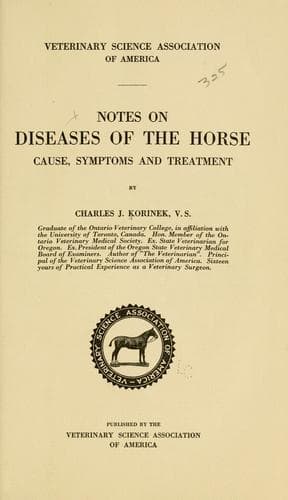
Notes on Diseases of the Horse: Cause, Symptoms and TreatmentKorinek, Charles James
Science
Notes on Diseases of the Horse: Cause, Symptoms and Treatment
Korinek, Charles James
Horses -- Diseases
There are several methods of removing the testicles and I will mention
only the Emasculator method. This is the latest method of operation,
and gives results that are satisfactory in majority of cases. In my
opinion it is the best and most humane. Open the scrotum and allow the
testicles to protrude, being careful to make the opening sufficiently
large. When the testicles protrude sufficiently far from the opening in
the scrotum, pour some cresol and cotton-seed oil (20 drops of cresol
to an ounce of cotton-seed oil) around the cords and into the scrotum.
Apply it thoroughly in order to prevent its healing too rapidly. Open the
emasculator and place it around the cord, shove up as far as possible on
the cord without pulling or using force. Should the patient pull upon
the cord it is better to suspend operation for a time until he ceases,
as the length of the cord cannot be ascertained unless it is slack when
the emasculator is placed at the proper point. Tighten up the instrument
by means of pressing the two handles together until the testicle is
squeezed off. This makes a peculiarly dull cut, different from that of a
sharp knife and thus has the effect of closing the end of the artery and
preventing the flow of blood. Some veterinarians take off both testicles
at the same time. There is, however, more danger from bleeding in this
way, and I recommend that each be taken off separately. The patient may
be allowed to regain his feet as soon as the testicles are removed. I
desire to add again that it is absolutely necessary to see that the hands
of the operator and the instruments are thoroughly cleansed both before
and after the operation.
BLEEDING AFTER CASTRATION.—Frequently you will be called on to stop
bleeding after veterinaries or farmers have used some obsolete method of
castration, and I would recommend that you use either of the following
suggestions:
If bleeding is from the little artery in the back portion of the cord, it
will generally stop of its own accord, but if it should continue to bleed
for 30 minutes, throw clean, cold water against the part.
When bleeding is from the large artery in front of the cord, it is
considered dangerous. The artery should be tied with a silk thread if
possible, or twisted with a pair of forceps. Occasionally the artery
cannot be found, in which case the hole in the scrotum should be plugged
with a clean cloth saturated with Tincture of Iron, which will clot the
blood and thus close the artery.
CHOKING.
This term applies to obstruction of the gullet as well as that of the
windpipe.
CAUSE.—Too rapid eating, from which pieces of carrots or other roots,
or a quantity of dry food becomes lodged in the gullet. Although
obstructions of the windpipe caused by drenching, or from food entering
the lungs, may not prove fatal for several days, an obstruction in the
gullet will kill a horse in a very short time.
Public-domain text, read in full here on John Shaqi.
Reviews
Reviews
No reviews yet
Be the first to share your thoughts on this work.
Join the Discussion
Join the discussion
Sign in to leave a comment or review.
Sign InorCreate an account