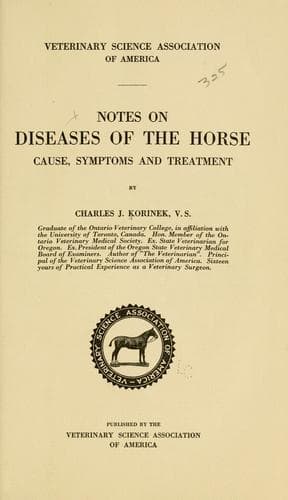
Notes on Diseases of the Horse: Cause, Symptoms and Treatment — John Shaqi
Notes on Diseases of the Horse: Cause, Symptoms and TreatmentKorinek, Charles James
Science
Notes on Diseases of the Horse: Cause, Symptoms and Treatment
Korinek, Charles James
Horses -- Diseases
CAUSE.—Contraction of the neck of the womb, growths on or in the ovaries,
Whites or Leucorrhea. The first is the only form of barrenness which
responds readily to treatment.
SYMPTOMS.—A mare may come in heat normally, or stay in heat continually,
or not come in heat at all.
TREATMENT.—Wash the hands in some antiseptic solution, such as Carbolic
Acid or Bichloride of Mercury, and see that the finger-nails are smooth.
Grease the hand and arm with vaseline and proceed to dilate the neck of
the womb. It may be difficult at first to insert the finger, but the
opening will gradually enlarge. Work slowly and carefully until three
fingers may be inserted. Breeding should follow about three hours after
the womb has been dilated.
BLEEDING.
(_Hemorrhage_)
Bleeding sometimes follows operations as castration and wounds due to
various causes.
TREATMENT.—When bleeding from a large artery, it should be tied with
a clean silk or linen thread or twisted with a pair of forceps or
cauterized with a hot iron. Sometimes compression by the use of tightly
bound bandages proves effective, although the former appliances are
more practical. Tincture chloride of iron, applied to small arteries
or veins, causes the blood to clot in the arteries or veins, and hence
stops the hemorrhage. It is very essential that all wounds should be
treated antiseptically and I cannot say that I am in favor of washing
a wound with water only in cases where the wound is very filthy, and I
prefer powder applications in preference to any liquid antiseptics. The
following will be found very effective in the treatment of the majority
of wounds: Boracic acid, two ounces; iodoform, two drams; tannic acid,
two ounces; calomel, one dram; powder finely and mix well. Place in
sifter top can and apply two or three times daily.
BLOOD POISONING.
(_Septicaemia or Pyemia_)
CAUSE.—By the popular term, “Blood Poison,” is meant a state of
constitutional disturbance brought on by the entrance of putrid
products—usually from a wound—into the blood. As a rule some pressure
or inoculation is necessary for the introduction of poison into the
circulation; hence, the necessity of free drainage and thorough
disinfection of the wound, and the only hopeful cases are those in which
by this means the supply of poison may be cut short.
SYMPTOMS.—It is introduced through any wound or abrasion, whether due to
injury, disease or by an operation. Signs of septic poison are heat, pain
and swelling.
Public-domain text, read in full here on John Shaqi.
Reviews
Reviews
No reviews yet
Be the first to share your thoughts on this work.
Join the Discussion
Join the discussion
Sign in to leave a comment or review.
Sign InorCreate an account