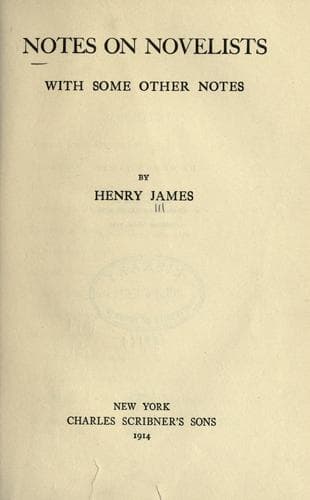
Notes on Novelists, with Some Other NotesJames, Henry
History
Notes on Novelists, with Some Other Notes
James, Henry
Fiction -- History and criticism; Novelists
flourishes, the little technical amusements of his penetrating power.
But it is doubtless in his hand for such a matter as the jealous passion
of Louise de Chaulieu, the free play of her intelligence and the almost
beautiful good faith of her egotism, that he is most individual. It is
one of the neatest examples of his extraordinary leading gift, his
art—which is really moreover not an art—of working the exhibition of a
given character up to intensity. I say it is not an art because it acts
for us rather as a hunger on the part of his nature to take on in all
freedom another nature—take it by a direct process of the senses. Art
is for the mass of us who have only the process of art, comparatively so
stiff. The thing amounts with him to a kind of shameless personal,
physical, not merely intellectual, duality—the very spirit and secret
of transmigration.
HONORÉ DE BALZAC
1913
It is a pleasure to meet M. Émile Faguet[5] on the same ground of
mastered critical method and in the same air of cool deliberation and
conclusion that so favoured his excellent study of Flaubert in the rich
series to which the present volume belongs. It was worth while waiting
these many years for a Balzac to get it at last from a hand of so firm a
grip, if not quite of the very finest manipulative instinct. It can
scarce ever be said of M. Faguet that he tends to play with a subject,
at least a literary one; but nobody is better for circling his theme in
sound and easy pedestrian fashion, for taking up each of its aspects in
order, for a sense, above all, of the order in which they _should_ be
taken, and for then, after doing them successively justice, reaching the
point from which they appear to melt together. He thus gives us one of
those literary portraits the tradition of which, so far at least as they
are the fruit of method, has continued scantily to flourish among
ourselves. We cannot help thinking indeed that an ideally authoritative
portrait of Balzac would be the work of some pondering painter able to
measure the great man’s bequest a little more from within or by a
coincidence of special faculty, or that in other words the particular
initiation and fellow-feeling of some like—that is not too
unlike—imaginative projector as well are rather wanted here to warm and
colour the critical truth to the right glow of appreciation. Which comes
to saying, we quite acknowledge, that a “tribute” to Balzac, of however
embracing an intention, may still strike us as partly unachieved if we
fail to catch yearning and shining through it, like a motive in a
musical mixture or a thread of gold in a piece of close weaving, the all
but overriding sympathy of novelist with novelist. M. Faguet’s
intelligence at any rate sweeps his ground clear of the anecdotal, the
question-begging reference to odds and ends of the personal and
superficial, in a single short chapter, and, having got so promptly over
Public-domain text, read in full here on John Shaqi.
Reviews
Reviews
No reviews yet
Be the first to share your thoughts on this work.
Elsewhere in the archive
Join the Discussion
Join the discussion
Sign in to leave a comment or review.
Sign InorCreate an account