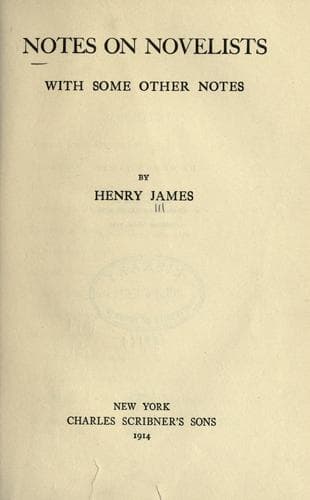
Notes on Novelists, with Some Other NotesJames, Henry
History
Notes on Novelists, with Some Other Notes
James, Henry
Fiction -- History and criticism; Novelists
this second line of defence, attacks at once the issue of his author’s
general ideas—matters apt to be, in any group of contributors to a
“series” of our own, exactly what the contributor most shirks
considering.
It is true that few writers, and especially few novelists, bring up that
question with anything like the gross assurance and systematic
confidence of Balzac, who clearly took for involved in his plan of a
complete picture of the manners and aspects of his country and his
period that he should have his confident “say” about as many things as
possible, and who, throughout his immense work, appears never for an
instant or in any connection to flinch from that complacency. Here it is
easy to await him, waylay him and catch him in the act, with the
consequence, for the most part, of our having to recognise almost with
compassion the disparity between the author of “La Cousine Bette”
exercising his genius, as Matthew Arnold said of Ruskin, in making a
like distinction, and the same writer taking on a character not in the
least really rooted in that soil. The fact none the less than his
generalising remains throughout so markedly inferior to his
particularising—which latter element and very essence of the novelist’s
art it was his greatness to carry further and apply more consistently
than any member of the craft, without exception, has felt the impulse,
to say nothing of finding the way, to do—by no means wholly destroys
the interest of the habit itself or relieves us of a due attention to
it; so characteristic and significant, so suggestive even of his special
force, though in a manner indirect, are the very folds and redundancies
of this philosopher’s robe that flaps about his feet and drags along the
ground like an assumed official train. The interest here—where it is
exactly that a whole face of his undertaking would be most illumined for
the fellow-artist we imagine trying to exhibit him—depends much less on
what his reflection and opinion, his irrepressible _obiter dicta_ and
monstrous _suffisances_ of judgment may be, than on the part played in
his scheme by his holding himself ready at every turn and at such short
notice to judge. For this latter fact probably lights up more than any
other his conception of the range of the novel, the fashion after which,
in his hands, it had been felt as an all-inclusive form, a form without
rift or leak, a tight mould, literally, into which everything relevant
to a consideration of the society surrounding him—and the less relevant
unfortunately, as well as the more—might be poured in a stream of
increasing consistency, the underlapping subject stretched, all so
formidably, to its own constituted edge and the compound appointed to
reproduce, as in finest and subtlest relief, its every minutest feature,
overlying and corresponding with it all round to the loss of no fraction
of an inch.
Public-domain text, read in full here on John Shaqi.
Reviews
Reviews
No reviews yet
Be the first to share your thoughts on this work.
Elsewhere in the archive
Join the Discussion
Join the discussion
Sign in to leave a comment or review.
Sign InorCreate an account