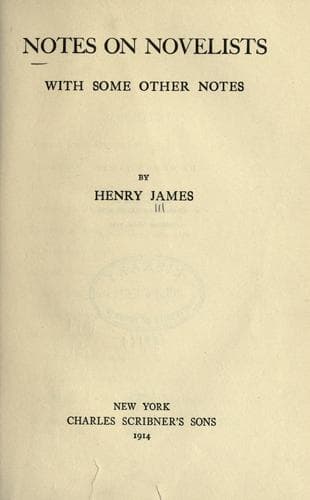
Notes on Novelists, with Some Other NotesJames, Henry
History
Notes on Novelists, with Some Other Notes
James, Henry
Fiction -- History and criticism; Novelists
always thrown back on that; we can’t get out of it; all we can do is to
say that the true itself can’t be more than done and that if the false
in this way equals it we must give up looking for the difference. Alone
among novelists Balzac has the secret of an insistence that somehow
makes the difference nought. He warms his facts into life—as witness
the certainty that the episode I just cited has absolutely as much of
that property as if perfect matching had been achieved. If the great
ladies in question _didn’t_ behave, wouldn’t, couldn’t have behaved,
like a pair of nervous snobs, why so much the worse, we say to
ourselves, for the great ladies in question. We _know_ them so—they owe
their being to our so seeing them; whereas we never can tell ourselves
how we should otherwise have known them or what quantity of being they
would on a different footing have been able to put forth.
The case is the same with Louise de Chaulieu, who besides coming out of
her convent school, as a quite young thing, with an amount of
sophistication that would have chilled the heart of a horse-dealer,
exhales—and to her familiar friend, a young person of a supposedly
equal breeding—an extravagance of complacency in her “social position”
that makes us rub our eyes. Whereupon after a little the same phenomenon
occurs; we swallow her bragging, against our better reason, or at any
rate against our startled sense, under coercion of the total intensity.
We do more than this, we cease to care for the question, which loses
itself in the hot fusion of the whole picture. He has “gone for” his
subject, in the vulgar phrase, with an avidity that makes the attack of
his most eminent rivals affect us as the intercourse between introduced
indifferences at a dull evening party. He squeezes it till it cries out,
we hardly know whether for pleasure or pain. In the case before us for
example—without wandering from book to book, impossible here, I make
the most of the ground already broken—he has seen at once that the
state of marriage itself, sounded to its depths, is, in the connection,
his real theme. He sees it of course in the conditions that exist for
him, but he weighs it to the last ounce, feels it in all its dimensions,
as well as in all his own, and would scorn to take refuge in any
engaging side-issue. He gets, for further intensity, into the very skin
of his _jeunes mariées_—into each alternately, as they are different
enough; so that, to repeat again, any other mode of representing women,
or of representing anybody, becomes, in juxtaposition, a thing so void
of the active contortions of truth as to be comparatively wooden. He
bears children with Madame de l’Estorade, knows intimately how she
suffers for them, and not less intimately how her correspondent suffers,
as well as enjoys, without them. Big as he is he makes himself small to
be handled by her with young maternal passion and positively to handle
her in turn with infantile innocence. These things are the very
Public-domain text, read in full here on John Shaqi.
Reviews
Reviews
No reviews yet
Be the first to share your thoughts on this work.
Elsewhere in the archive
Join the Discussion
Join the discussion
Sign in to leave a comment or review.
Sign InorCreate an account