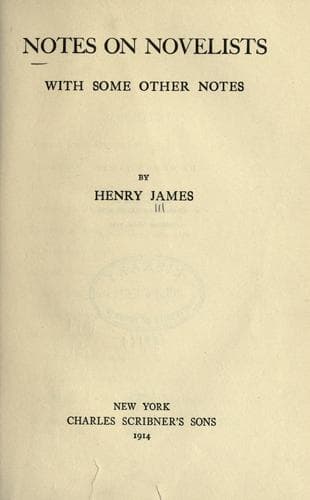
Notes on Novelists, with Some Other NotesJames, Henry
History
Notes on Novelists, with Some Other Notes
James, Henry
Fiction -- History and criticism; Novelists
It is thus the painter’s aspiring and rejoicing consciousness of the
great square swarming picture, the picture of France from side to side
and from top to bottom, which he proposes to copy—unless we see the
collective quantity rather as the vast primary model or sitter that he
is unprecedentedly to portray, it is this that, rendering him enviable
in proportion to his audacity and his presumption, gives a dignity to
everything that makes the consciousness whole. The result is a state of
possession of his material unlike that of any other teller of tales
whatever about a circumjacent world, and the process of his gain of
which opens up well-nigh the first of those more or less baffling
questions, parts indeed of the great question of the economic rule, the
practical secret, of his activity, that beset us as soon as we study
him. To fit what he was and what he did, that is the measure of how he
used himself and how he used every one and everything else, into his
after all so brief career (for twenty years cover the really productive
term of it) is for ourselves, we confess, to renounce any other solution
than that of his having proceeded by a sense for facts, the
multitudinous facts of the scene about him, that somehow involved a
preliminary, a pre-experiential inspiration, a straightness of intuition
truly impossible to give an account of and the like of which had never
before been shown. He had not to learn things in order to know them; and
even though he multiplied himself in more ways than we can reckon up,
going hither and thither geographically, leading his life with violence,
as it were, though always with intention, and wasting almost nothing
that had ever touched him, the natural man, the baptised and registered
Honoré, let loose with harsh promptitude upon a world formed from the
first moment to excite his voracity, can only have been _all_ the
exploiting agent, the pushing inquirer, the infallible appraiser, the
subject of an _arrière-pensée_ as merciless, in spite of being otherwise
genial, as the black care riding behind the horseman. There was thus
left over for him less of mere human looseness, of mere emotion, of mere
naturalness, or of any curiosity whatever, that didn’t “pay”—and the
extent to which he liked things to pay, to see them, think of them, and
describe them as prodigiously paying, is not to be expressed—than
probably marks any recorded relation between author and subject as we
know each of these terms.
Public-domain text, read in full here on John Shaqi.
Reviews
Reviews
No reviews yet
Be the first to share your thoughts on this work.
Elsewhere in the archive
Join the Discussion
Join the discussion
Sign in to leave a comment or review.
Sign InorCreate an account