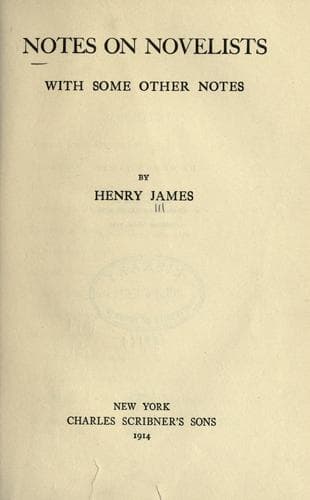
Notes on Novelists, with Some Other NotesJames, Henry
History
Notes on Novelists, with Some Other Notes
James, Henry
Fiction -- History and criticism; Novelists
So it comes that his mastership of whatever given identity might be in
question, and much more of the general identity of his rounded (for the
artistic vision), his compact and containing France, the fixed, felt
frame to him of the vividest items and richest characteristics of human
life, can really not be thought of as a matter of degrees of confidence,
as acquired or built up or cumbered with verifying fears. He _was_ the
given identity and, on the faintest shade of a hint about it caught up,
became one with it and lived it—this in the only way in which he could
live, anywhere or at any time: which was by losing himself in its
relation to his need or to what we call his voracity. Just so his mind,
his power of apprehension, worked _naturally_ in the interest of a
society disclosed to that appetite; on the mere approach to the display
he inhaled information, he recognised himself as what he might best be
known for, an historian unprecedented, an historian documented as none
had not only ever been, but had ever dreamed of being—and even if the
method of his documentation can leave us for the most part but
wondering. The method of his use of it, or of a portion of it, we more
or less analyse and measure; but the wealth of his provision or outfit
itself, the crammed store of his categories and _cadres_, leaves us the
more stupefied as we feel it to have been honestly come by. All this is
what it is impossible not to regard as in itself a fundamental felicity
as no _confrère_ had known; so far, indeed, as Balzac suffered
_confrères_ or as the very nature of his faculty could be thought of for
them. M. Brunetière’s monograph of some years ago, which is but a couple
of degrees less weighty, to our sense, than this of M. Faguet before us,
justly notes that, whatever other felicity may have graced the exercise
of such a genius, for instance, as that rare contemporary George Sand,
she was reduced well-nigh altogether to drawing upon resources and
enjoying advantages comparatively vague and unassured. She had of course
in a manner her special resource and particular advantage, which
consisted, so to speak, in a finer feeling about what she did possess
and could treat of with authority, and particularly in a finer command
of the terms of expression, than any involved in Balzac’s “happier”
example. But her almost fatal weakness as a novelist—an exponent of the
art who has waned exactly as, for our general long-drawn appreciation,
Balzac has waxed—comes from her having had to throw herself upon ground
that no order governed, no frame, as we have said, enclosed, and no
safety attended; safety of the sort, we mean, the safety of the
constitutive, illustrative fact among facts, which we find in her rival
as a warm socialised air, an element supremely assimilable.
Public-domain text, read in full here on John Shaqi.
Reviews
Reviews
No reviews yet
Be the first to share your thoughts on this work.
Elsewhere in the archive
Join the Discussion
Join the discussion
Sign in to leave a comment or review.
Sign InorCreate an account