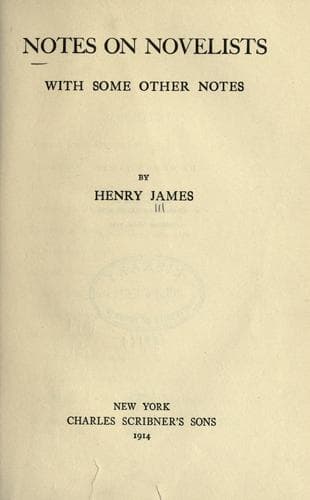
Notes on Novelists, with Some Other NotesJames, Henry
History
Notes on Novelists, with Some Other Notes
James, Henry
Fiction -- History and criticism; Novelists
It may freely be pronounced interesting that whereas, in her instinct
for her highest security, she threw herself upon the consideration of
love as the _type_ attraction or most representable thing in the human
scene, so, assuredly, no student of that field has, in proportion to the
thoroughness of his study, felt he could afford to subordinate or almost
even to neglect it to anything like the tune in which we see it put and
kept in its place through the parts of the Comédie Humaine that most
count. If this passion but too often exhales a tepid breath in much
other fiction—much other of ours at least—that is apt to come
decidedly less from the writer’s sense of proportion than from his
failure of art, or in other words of intensity. It is rarely absent by
intention or by intelligence, it is pretty well always there as the
theoretic principal thing—any difference from writer to writer being
mostly in the power to put the principal thing effectively forward. It
figures as a pressing, an indispensable even if a perfunctory motive,
for example, in every situation devised by Walter Scott; the case being
simply that if it doesn’t in fact attractively occupy the foreground
this is because his hand has had so native, so much greater, an ease for
other parts of the picture. What makes Balzac so pre-eminent and
exemplary that he was to leave the novel a far other and a vastly more
capacious and significant affair than he found it, is his having felt
his fellow-creatures (almost altogether for him his contemporaries) as
quite failing of reality, as swimming in the vague and the void and the
abstract, unless their social conditions, to the last particular, their
generative and contributive circumstances, of every discernible sort,
enter for all these are “worth” into his representative attempt. This
great compound of the total looked into and starting up in its element,
as it always does, to meet the eye of genius and patience half way,
bristled for him with all its branching connections, those thanks to
which any figure could _be_ a figure but by showing for endlessly
entangled in them.
Public-domain text, read in full here on John Shaqi.
Reviews
Reviews
No reviews yet
Be the first to share your thoughts on this work.
Elsewhere in the archive
Join the Discussion
Join the discussion
Sign in to leave a comment or review.
Sign InorCreate an account