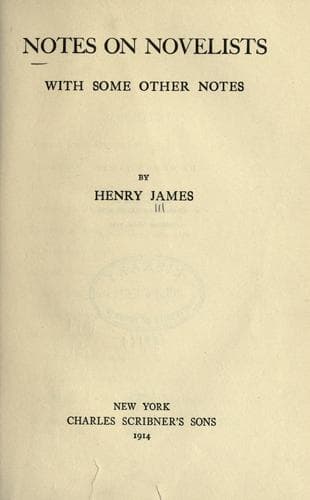
Notes on Novelists, with Some Other NotesJames, Henry
History
Notes on Novelists, with Some Other Notes
James, Henry
Fiction -- History and criticism; Novelists
This discussion is precisely all the sharper because it takes place for
each of us within as well as without. When we wish to know at all we
wish to know everything; yet there happen to be certain things of which
no better description can be given than that they are simply none of our
business. “What _is_ then forsooth of our business?” the genuine analyst
may always ask; and he may easily challenge us to produce any rule of
general application by which we shall know when to push in and when to
back out. “In the first place,” he may continue, “half the ‘interesting’
people in the world have at one time or another set themselves to drag
us in with all their might; and what in the world in such a relation is
the observer that he should absurdly pretend to be in more of a flutter
than the object observed? The mannikin, in all schools, is at an early
stage of study of the human form inexorably superseded by the man. Say
that we are to give up the attempt to understand: it might certainly be
better so, and there would be a delightful side to the new arrangement.
But in the name of common-sense don’t say that the continuity of life is
not to have some equivalent in the continuity of pursuit, the renewal of
phenomena in the renewal of notation. There is not a door you can lock
here against the critic or the painter, not a cry you can raise or a
long face you can pull at him, that are not quite arbitrary things. The
only thing that makes the observer competent is that he is neither
afraid nor ashamed; the only thing that makes him decent—just
think!—is that he is not superficial.” All this is very well, but
somehow we all equally feel that there is clean linen and soiled and
that life would be intolerable without some acknowledgment even by the
pushing of such a thing as forbidden ground. M. Émile Zola, at the
moment I write, gives to the world his reasons for rejoicing in the
publication of the physiological _enquête_ of Dr. Toulouse—a marvellous
catalogue or handbook of M. Zola’s outward and inward parts, which
leaves him not an inch of privacy, so to speak, to stand on, leaves him
nothing about himself that is _for_ himself, for his friends, his
relatives, his intimates, his lovers, for discovery, for emulation, for
fond conjecture or flattering deluded envy. It is enough for M. Zola
that everything is for the public and no sacrifice worth thinking of
when it is a question of presenting to the open mouth of that apparently
gorged but still gaping monster the smallest spoonful of truth. The
truth, to his view, is never either ridiculous or unclean, and the way
to a better life lies through telling it, so far as possible, about
everything and about every one.
Public-domain text, read in full here on John Shaqi.
Reviews
Reviews
No reviews yet
Be the first to share your thoughts on this work.
Elsewhere in the archive
Join the Discussion
Join the discussion
Sign in to leave a comment or review.
Sign InorCreate an account