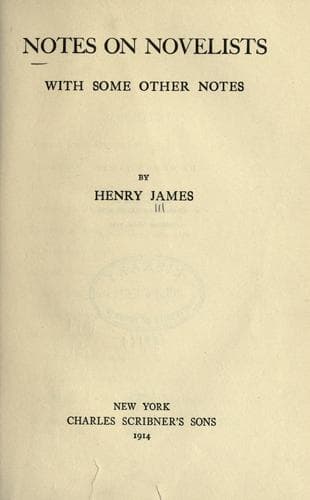
Notes on Novelists, with Some Other NotesJames, Henry
History
Notes on Novelists, with Some Other Notes
James, Henry
Fiction -- History and criticism; Novelists
By our unhappy pair at any rate the luxury in question—the little
luxury of plainer folk—was not to be purchased, and in the comedy of
their despair and the tragedy of their recovery nothing is more striking
than their convulsive effort either to reach up to it or to do without
it. They would have given for it all else they possessed, but they only
meet in their struggle the inexorable _never_. They strain and pant and
gasp, they beat the air in vain for the cup of cold water of their hell.
They missed it in a way for which none of their superiorities could make
up. Their great affliction was that each found in the life of the other
an armoury of weapons to wound. Young as they were, young as Musset was
in particular, they appeared to have afforded each other in that
direction the most extraordinary facilities; and nothing in the matter
of the mutual consideration that failed them is more sad and strange
than that even in later years, when their rage, very quickly, had
cooled, they never arrived at simple silence. For Madame Sand, in her so
much longer life, there was no hush, no letting alone; though it would
be difficult indeed to exaggerate the depth of relative indifference
from which, a few years after Musset’s death, such a production as “Elle
et Lui” could spring. Of course there had been floods of tenderness, of
forgiveness; but those, for all their beauty of expression, are quite
another matter. It is just the fact of our sense of the ugliness of so
much of the episode that makes a wonder and a force of the fine style,
all round, in which it is offered us. That force is in its turn a sort
of clue to guide, or perhaps rather a sign to stay, our feet in paths
after all not the most edifying. It gives a degree of importance to the
somewhat squalid and the somewhat ridiculous story, and, for the old
George-Sandist at least, lends a positive spell to the smeared and
yellowed paper, the blotted and faded ink. In this twilight of
association we seem to find a reply to our own challenge and to be able
to tell ourselves why we meddle with such old dead squabbles and waste
our time with such grimacing ghosts. If we were superior to the
weakness, moreover, how should we make our point (which we must really
make at any cost) as to the so valuable vivid proof that a great talent
is the best guarantee—that it may really carry off almost anything?
Public-domain text, read in full here on John Shaqi.
Reviews
Reviews
No reviews yet
Be the first to share your thoughts on this work.
Elsewhere in the archive
Join the Discussion
Join the discussion
Sign in to leave a comment or review.
Sign InorCreate an account