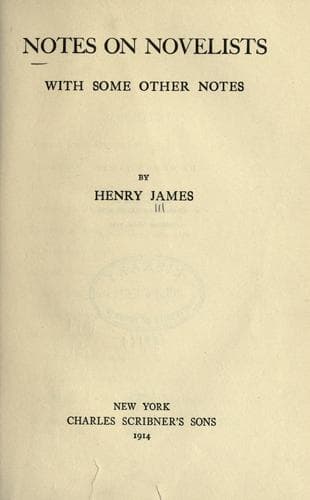
Notes on Novelists, with Some Other NotesJames, Henry
History
Notes on Novelists, with Some Other Notes
James, Henry
Fiction -- History and criticism; Novelists
The rather sorry ghost that beckons us on furthest is the rare
personality of Madame Sand. Under its influence—or that of old memories
from which it is indistinguishable—we pick our steps among the
_laideurs_ aforesaid: the misery, the levity, the brevity of it all, the
greatest ugliness in particular that this life shows us, the way the
devotions and passions that we see heaven and earth called to witness
are over before we can turn round. It may be said that, for what it was,
the intercourse of these unfortunates surely lasted long enough; but the
answer to that is that if it had only lasted longer it wouldn’t have
been what it was. It was not only preceded and followed by intimacies,
on one side and the other, as unadorned by the stouter sincerity, but
was mixed up with them in a manner that would seem to us dreadful if it
didn’t still more seem to us droll, or rather perhaps if it didn’t
refuse altogether to come home to us with the crudity of contemporary
things. It is antediluvian history, a queer vanished world—another
Venice from the actually, the deplorably familiarised, a Paris of
greater bonhomie, an inconceivable impossible Nohant. This relegates it
to an order agreeable somehow to the imagination of the fond
quinquegenarian, the reader with a fund of reminiscence. The vanished
world, the Venice unrestored, the Paris unextended, is a bribe to his
judgment; he has even a glance of complacency for the lady’s liberal
_foyer_. Liszt, one lovely year at Nohant, “jouait du piano au
rez-de-chaussée, et les rossignols, ivres de musique et de soleil,
s’égosillaient avec rage sur les lilas environnants.” The beautiful
manner confounds itself with the conditions in which it was exercised,
the large liberty and variety overflow into admirable prose, and the
whole thing makes a charming faded medium in which Chopin gives a hand
to Consuelo and the small Fadette has her elbows on the table of
Flaubert.
Public-domain text, read in full here on John Shaqi.
Reviews
Reviews
No reviews yet
Be the first to share your thoughts on this work.
Elsewhere in the archive
Join the Discussion
Join the discussion
Sign in to leave a comment or review.
Sign InorCreate an account