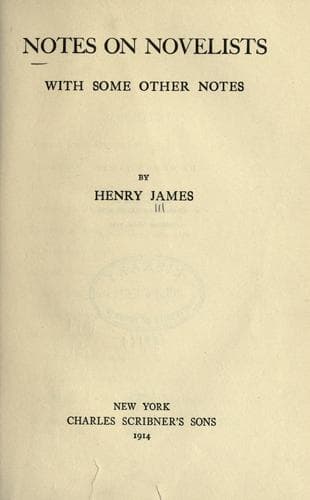
Notes on Novelists, with Some Other NotesJames, Henry
History
Notes on Novelists, with Some Other Notes
James, Henry
Fiction -- History and criticism; Novelists
There is a terrible letter of the autumn of 1834 in which our heroine
has recourse to Alfred Tattet on a dispute with the bewildered
Pagello—a disagreeable matter that involved a question of money. “À
Venise il comprenait,” she somewhere says, “à Paris il ne comprend
plus.” It was a proof of remarkable intelligence that he did understand
in Venice, where he had become a lover in the presence and with the
exalted approval of an immediate predecessor—an alternate
representative of the part, whose turn had now, on the removal to Paris,
come round again and in whose resumption of office it was looked to him
to concur. This attachment—to Pagello—had lasted but a few months; yet
already it was the prey of complication and change, and its sun appears
to have set in no very graceful fashion. We are not here in truth among
very graceful things, in spite of superhuman attitudes and great
romantic flights. As to these forced notes Madame Arvède Barine
judiciously says that the picture of them contained in the letters to
which she had had access, and some of which are before us, “presents an
example extraordinary and unmatched of what the romantic spirit could do
with beings who had become its prey.” She adds that she regards the
records in question, “in which we follow step by step the ravages of the
monster,” as “one of the most precious psychological documents of the
first half of the century.” That puts the story on its true footing,
though we may regret that it should not divide these documentary honours
more equally with some other story in which the monster has not quite so
much the best of it. But it is the misfortune of the comparatively short
and simple annals of conduct and character that they should ever seem to
us somehow to cut less deep. Scarce—to quote again his best
biographer—had Musset, at Venice, begun to recover from his illness
than the two lovers were seized afresh by _le vertige du sublime et de
l’impossible_. “Ils imaginèrent les déviations de sentiment les plus
bizarres, et leur intérieur fut le théâtre de scènes qui égalaient en
étrangeté les fantaisies les plus audacieuses de la littérature
contemporaine;” that is of the literature of their own day. The register
of virtue contains no such lively items—save indeed in so far as these
contortions and convulsions were a conscious tribute to virtue.
Public-domain text, read in full here on John Shaqi.
Reviews
Reviews
No reviews yet
Be the first to share your thoughts on this work.
Elsewhere in the archive
Join the Discussion
Join the discussion
Sign in to leave a comment or review.
Sign InorCreate an account