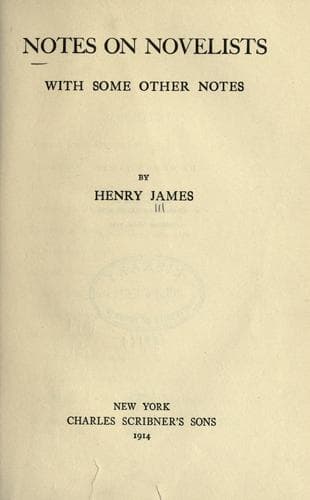
Notes on Novelists, with Some Other NotesJames, Henry
History
Notes on Novelists, with Some Other Notes
James, Henry
Fiction -- History and criticism; Novelists
Ten weeks after Musset has left her in Venice his relinquished but not
dissevered mistress writes to him in Paris: “God keep you, my friend, in
your present disposition of heart and mind. Love is a temple built by
the lover to an object more or less worthy of his worship, and what is
grand in the thing is not so much the god as the altar. Why should you
be afraid of the risk?”—of a new mistress she means. There would seem
to be reasons enough why he should have been afraid, but nothing is more
characteristic than her eagerness to push him into the arms of another
woman—more characteristic either of her whole philosophy in these
matters or of their tremendous, though somewhat conflicting, effort to
be good. She is to be good by showing herself so superior to jealousy as
to stir up in him a new appetite for a new object, and he is to be so by
satisfying it to the full. It appears not to occur to either one that in
such an arrangement his own honesty is rather sacrificed. Or is it
indeed because he has scruples—or even a sense of humour—that she
insists with such ingenuity and such eloquence? “Let the idol stand long
or let it soon break, you will in either case have built a beautiful
shrine. Your soul will have lived in it, have filled it with divine
incense, and a soul like yours must produce great works. The god will
change perhaps, the temple will last as long as yourself.” “Perhaps,”
under the circumstances, was charming. The letter goes on with the ample
flow that was always at the author’s command—an ease of suggestion and
generosity, of beautiful melancholy acceptance, in which we foresee, on
her own horizon, the dawn of new suns. Her simplifications are
delightful—they remained so to the end; her touch is a wondrous
sleight-of-hand. The whole of this letter in short is a splendid
utterance and a masterpiece of the shade of sympathy, not perhaps the
clearest, which consists of wishing another to feel as you feel
yourself. To feel as George Sand felt, however, one had to be, like
George Sand, of the true male inwardness; which poor Musset was far from
being. This, we surmise, was the case with most of her lovers, and the
truth that makes the idea of her _liaison_ with Mérimée, who _was_ of a
consistent virility, sound almost like a union against nature. She
repeats to her correspondent, on grounds admirably stated, the
injunction that he is to give himself up, to let himself go, to take his
chance. That he took it we all know—he followed her advice only too
well. It is indeed not long before his manner of doing so draws from her
a cry of distress. “Ta conduite est déplorable, impossible. Mon Dieu, à
quelle vie vais-je te laisser? l’ivresse, le vin, les filles, et encore
et toujours!” But apprehensions were now too late; they would have been
too late at the very earliest stage of this celebrated connection.
III
Public-domain text, read in full here on John Shaqi.
Reviews
Reviews
No reviews yet
Be the first to share your thoughts on this work.
Elsewhere in the archive
Join the Discussion
Join the discussion
Sign in to leave a comment or review.
Sign InorCreate an account