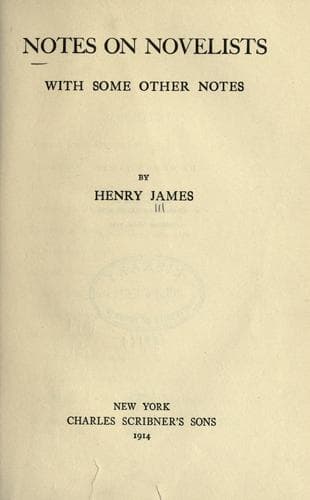
Notes on Novelists, with Some Other NotesJames, Henry
History
Notes on Novelists, with Some Other Notes
James, Henry
Fiction -- History and criticism; Novelists
For the rest, in any case, with her free experience and her free use of
it, her literary style, her love of ideas and questions, of science and
philosophy, her comradeship, her boundless tolerance, her intellectual
patience, her personal good-humour and perpetual tobacco (she smoked
long before women at large felt the cruel obligation), with all these
things and many I don’t mention she had more of the inward and outward
of the other sex than of her own. She had above all the mark that, to
speak at this time of day with a freedom for which her action in the
matter of publicity gives us warrant, the history of her personal
passions reads singularly like a chronicle of the ravages of some male
celebrity. Her relations with men closely resembled those relations with
women that, from the age of Pericles or that of Petrarch, have been
complacently commemorated as stages in the unfolding of the great
statesman and the great poet. It is very much the same large list, the
same story of free appropriation and consumption. She appeared in short
to have lived through a succession of such ties exactly in the manner of
a Goethe, a Byron or a Napoleon; and if millions of women, of course, of
every condition, had had more lovers, it was probable that no woman
independently so occupied and so diligent had had, as might be said,
more unions. Her fashion was quite her own of extracting from this sort
of experience all that it had to give her and being withal only the more
just and bright and true, the more sane and superior, improved and
improving. She strikes us as in the benignity of such an intercourse
even more than maternal: not so much the mere fond mother as the
supersensuous grandmother of the wonderful affair. Is not that
practically the character in which Thérèse Jacques studies to present
herself to Laurent de Fauvel? the light in which “Lucrezia Floriani” (a
memento of a friendship for Chopin, for Liszt) shows the heroine as
affected toward Prince Karol and his friend? George Sand is too
inveterately moral, too preoccupied with that need to do good which is
in art often the enemy of doing well; but in all her work the
story-part, as children call it, has the freshness and good faith of a
monastic legend. It is just possible indeed that the moral idea was the
real mainspring of her course—I mean a sense of the duty of avenging on
the unscrupulous race of men their immemorial selfish success with the
plastic race of women. Did she wish above all to turn the tables—to
show how the sex that had always ground the other in the volitional mill
was on occasion capable of being ground?
Public-domain text, read in full here on John Shaqi.
Reviews
Reviews
No reviews yet
Be the first to share your thoughts on this work.
Elsewhere in the archive
Join the Discussion
Join the discussion
Sign in to leave a comment or review.
Sign InorCreate an account