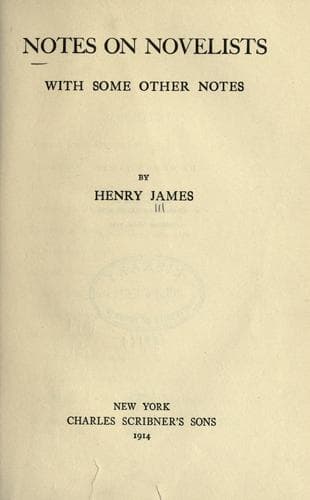
Notes on Novelists, with Some Other NotesJames, Henry
History
Notes on Novelists, with Some Other Notes
James, Henry
Fiction -- History and criticism; Novelists
However this may be, nothing is more striking than the inward impunity
with which she gave herself to conditions that are usually held to
denote or to involve a state of demoralisation. This impunity (to speak
only of consequences or features that concern us) was not, I admit,
complete, but it was sufficiently so to warrant us in saying that no one
was ever less demoralised. She presents a case prodigiously discouraging
to the usual view—the view that there is no surrender to
“unconsecrated” passion that we escape paying for in one way or another.
It is frankly difficult to see where this eminent woman conspicuously
paid. She positively got off from paying—and in a cloud of fluency and
dignity, benevolence, competence, intelligence. She sacrificed, it is
true, a handful of minor coin—suffered by failing wholly to grasp in
her picture of life certain shades and certain delicacies. What she paid
was this irrecoverable loss of her touch for them. That is undoubtedly
one of the reasons why to-day the picture in question has perceptibly
faded, why there are persons who would perhaps even go so far as to say
that it has really a comic side. She doesn’t know, according to such
persons, her right hand from her left, the crooked from the straight and
the clean from the unclean: it was a sense she lacked or a tact she had
rubbed off, and her great work is by the fatal twist quite as lopsided a
monument as the leaning tower of Pisa. Some readers may charge her with
a graver confusion still—the incapacity to distinguish between fiction
and fact, the truth straight from the well and the truth curling in
steam from the kettle and preparing the comfortable tea. There is no
word oftener on her pen, they will remind us, than the verb to
“arrange.” She arranged constantly, she arranged beautifully; but from
this point of view, that of a general suspicion of arrangements, she
always proved too much. Turned over in the light of it the story of
“Elle et Lui” for instance is an attempt to prove that the mistress of
Laurent de Fauvel was little less than a prodigy of virtue. What is
there not, the intemperate admirer may be challenged to tell us, an
attempt to prove in “L’Histoire de ma Vie”?—a work from which we gather
every delightful impression but the impression of an impeccable
veracity.
Public-domain text, read in full here on John Shaqi.
Reviews
Reviews
No reviews yet
Be the first to share your thoughts on this work.
Elsewhere in the archive
Join the Discussion
Join the discussion
Sign in to leave a comment or review.
Sign InorCreate an account