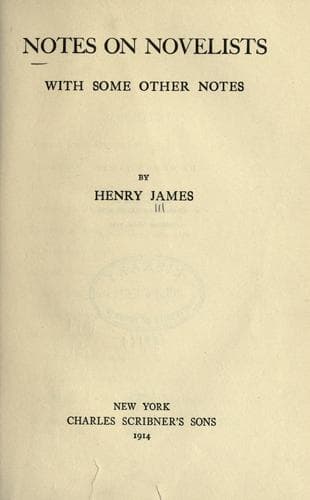
Notes on Novelists, with Some Other NotesJames, Henry
History
Notes on Novelists, with Some Other Notes
James, Henry
Fiction -- History and criticism; Novelists
These reservations may, however, all be sufficiently just without
affecting our author’s peculiar air of having eaten her cake and had it,
been equally initiated in directions the most opposed. Of how much cake
she partook the letters to Musset and Sainte-Beuve well show us, and yet
they fall in at the same time, on other sides, with all that was noble
in her mind, all that is beautiful in the books just mentioned and in
the six volumes of the general “Correspondance: 1812-1876,” out of which
Madame Sand comes so immensely to her advantage. She had, as liberty,
all the adventures of which the dots are so put on the i’s by the
documents lately published, and then she had, as law, as honour and
serenity, all her fine reflections on them and all her splendid busy
literary use of them. Nothing perhaps gives more relief to her masculine
stamp than the rare art and success with which she cultivated an
equilibrium. She made from beginning to end a masterly study of
composure, absolutely refusing to be upset, closing her door at last
against the very approach of irritation and surprise. She had arrived at
her quiet elastic synthesis—a good-humour, an indulgence that were an
armour of proof. The great felicity of all this was that it was neither
indifference nor renunciation, but on the contrary an intense partaking;
imagination, affection, sympathy and life, the way she had found for
herself of living most and living longest. However well it all agreed
with her happiness and her manners, it agrees still better with her
style, as to which we come back with her to the sense that this was
really her _point d’appui_ or sustaining force. Most people have to say,
especially about themselves, only what they can; but she said—and we
nowhere see it better than in the letters to Musset—everything in life
that she wanted. We can well imagine the effect of that consciousness on
the nerves of this particular correspondent, his own poor gift of
occasional song (to be so early spent) reduced to nothing by so
unequalled a command of the last word. We feel it, I hasten to add, this
last word, in all her letters: the occasion, no matter which, gathers it
from her as the breeze gathers the scent from the garden. It is always
the last word of sympathy and sense, and we meet it on every page of the
voluminous “Correspondance.” These pages are not so “clever” as those,
in the same order, of some other famous hands—the writer always denied,
justly enough, that she had either wit or presence of mind—and they are
not a product of high spirits or of a marked avidity for gossip. But
they have admirable ease, breadth and generosity; they are the clear
quiet overflow of a very full cup. They speak above all for the author’s
great gift, her eye for the inward drama. Her hand is always on the
fiddle-string, her ear is always at the heart. It was in the soul, in a
word, that she saw the drama begin, and to the soul that, after whatever
Public-domain text, read in full here on John Shaqi.
Reviews
Reviews
No reviews yet
Be the first to share your thoughts on this work.
Elsewhere in the archive
Join the Discussion
Join the discussion
Sign in to leave a comment or review.
Sign InorCreate an account