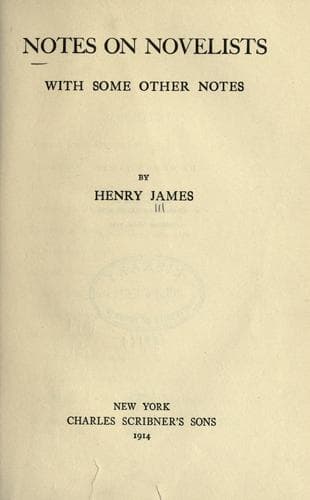
Notes on Novelists, with Some Other NotesJames, Henry
History
Notes on Novelists, with Some Other Notes
James, Henry
Fiction -- History and criticism; Novelists
The incident bears a family resemblance to another which our biographer
finds in her path in the year 1837. Having to chronicle the close of the
relation with Michel de Bourges, from which again her heroine had so
much to suffer, she has also to mention that this catastrophe was
precipitated, to all appearance, by the contemporaneous dawn of an
affection “plus douce, moins enthousiaste, moins âpre aussi, et j’espère
plus durable.” The object of this affection was none other than the
young man then installed at Nohant as preceptor to Madame Sand’s
children—but as to whom in the event we ask ourselves what by this time
her notion of measure or durability can have become. It is just this
element that has positively least to do, we seem to make out, with
“affection” as so practised. Affection in any sense worth speaking of
_is_ durability; and it is the repeated impermanence of those
manifestations of it on behalf of which the high horse of “passion” is
ridden so hard that makes us wonder whether such loves and such
licences, in spite of the quality of free experience they represent, had
really anything to do with it. It was surely the last thing they
contained. Félicien Mallefille may be, to his heart’s content, of 1837
and even of a portion of 1838; it is Chopin who is of the rest of the
year and—let us hope our biographer will have occasion to show us—of
at least the whole of the following. It is here that, as I have
mentioned, she pauses.
One of the most interesting contributions to her subject is the long
letter from Balzac to his future wife, Madame Hanska, now reproduced in
the most substantial of the few volumes of his correspondence (“Lettres
à l’Étrangère, 1833-1842,” published 1899) and printed by Madame
Karénine. The author, finding himself near Nohant in the spring of 1838,
went over to pay his illustrious colleague a visit and spent more than a
day in sustained conversation with her. He had the good fortune to find
her alone, so that they could endlessly talk and smoke by the fire, and
nothing can be all at once more vivid, more curious and more judicious
than his immediate report of the occasion. It lets into the whole
question of his hostess’s character and relations—inevitably more or
less misrepresented by the party most involved—air and light and truth;
it fixes points and re-establishes proportions. It shows appearances
confronted, in a word, with Balzac’s strong sense of the real and offers
the grateful critic still another chance to testify for that precious
gift. This same critic’s mind, it must be added, rests with complacency
on the vision thus evoked, the way that for three days, from five
o’clock in the afternoon till five in the morning, the wonderful friends
must have had things out. For once, we feel sure, fundamental questions
were not shirked. As regards his comrade at any rate Balzac puts his
finger again and again on the truth and the idiosyncrasy. “She is not
Public-domain text, read in full here on John Shaqi.
Reviews
Reviews
No reviews yet
Be the first to share your thoughts on this work.
Elsewhere in the archive
Join the Discussion
Join the discussion
Sign in to leave a comment or review.
Sign InorCreate an account