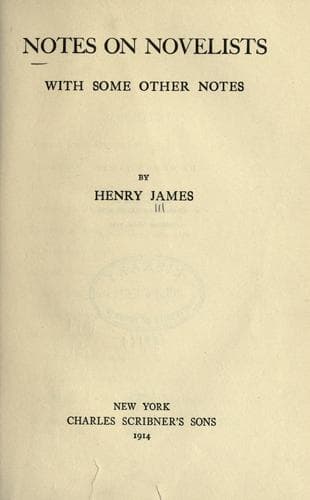
Notes on Novelists, with Some Other NotesJames, Henry
History
Notes on Novelists, with Some Other Notes
James, Henry
Fiction -- History and criticism; Novelists
_aimable_ and in consequence will always find it difficult to be loved.”
He adds—and it is here that he comes nearest straightening the
question—that she has in character all the leading marks of the man and
as few as possible those of his counterpart. He implies that, though
judged as a woman she may be puzzling enough, she hangs together
perfectly if judged as a man. She _is_ a man, he repeats, “and all the
more that she wants to be, that she has sunk the woman, that she isn’t
one. Women attract, and she repels; and, as I am much of a man, if this
is the effect she produces on me she must produce it on men who are like
me—so that she will always be unhappy.” He qualifies as justly, I may
parenthesise, her artistic side, the limits of which, he moreover
intimates, she had herself expressed to him. “She has neither intensity
of conception, nor the constructive gift, nor the faculty of reaching
the truth”—Balzac’s own deep dye of the truth—“nor the art of the
pathetic. But she holds that, without knowing the French language, she
has _style_. And it’s true.”
The light of mere evidence, the light of such researches as Madame
Karénine’s, added to her so copious correspondence and autobiography,
makes Madame Sand so much of a riddle that we grasp at Balzac’s
authoritative word as at an approach to a solution. It is, strange to
say, by reading another complexity into her image that we finally
simplify it. The riddle consists in the irreconcilability of her
distinction and her vulgarity. Vulgar somehow in spite of everything is
the record of so much taking and tasting and leaving, so much publicity
and palpability of “heart,” so much experience reduced only to the terms
of so many more or less greasy males. And not only vulgar but in a
manner grotesque—from the moment, that is, that the experience is
presented to us with any emphasis in the name of terror and pity. It was
not a passive but an active situation, that of a nature robust and not
too fastidious, full at all times of resistance and recovery. No history
gives us really more ground to protest against the new fashion, rife in
France, of transporting “love,” as there mainly represented, to the air
of morals and of melancholy. The fashion betrays only the need to
rejuvenate, at a considerable cost of falsity, an element in connection
with which levity is felt either to have exhausted itself or to look
thin as a motive. It is in the light of levity that many of the facts
presented by Madame Karénine are most intelligible, and that is the
circumstance awkward for sensibility and for all the graces it is
invited to show.
Public-domain text, read in full here on John Shaqi.
Reviews
Reviews
No reviews yet
Be the first to share your thoughts on this work.
Elsewhere in the archive
Join the Discussion
Join the discussion
Sign in to leave a comment or review.
Sign InorCreate an account