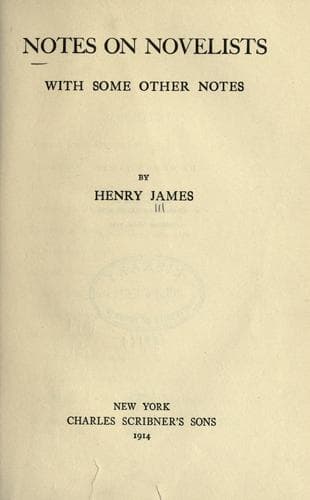
Notes on Novelists, with Some Other Notes — John Shaqi
Notes on Novelists, with Some Other NotesJames, Henry
History
Notes on Novelists, with Some Other Notes
James, Henry
Fiction -- History and criticism; Novelists
To read over some of his happiest things, to renew one’s sense of the
extraordinarily fine temper of his imagination, is to say to one’s self
“What a horse to have to ride every week to market!” We must all go to
market, but the most fortunate of us surely are those who may drive
thither, and on days not too frequent, nor by a road too rough, a ruder
and homelier animal. He touches in more than one place—and with notable
beauty and real authority in that little mine of felicities the “Letter
to a Young Gentleman”—on the conscience for “frugality” which should be
the artist’s finest point of honour: so that one of his complications
here was undoubtedly the sense that on this score his position had
inevitably become somewhat false. The literary romantic is by no means
necessarily expensive, but of the many ways in which the practical, the
active, has to be paid for this departure from frugality would be, it is
easy to conceive, not the least. And we perceive his recognising this as
he recognised everything—if not in time, then out of it; accepting
inconsistency, as he always did, with the gaiety of a man of
courage—not being, that is, however intelligent, priggish for logic and
the grocer’s book any more than for anything else. Only everything made
for keeping it up, and it was a great deal to keep up; though when he
throws off “The Ebb-Tide” and rises to “Catriona,” and then again to
“Weir of Hermiston,” as if he could rise to almost anything, we breathe
anew and look longingly forward. The latest of these letters contain
such admirable things, testify so to the reach of his intelligence and
in short vibrate so with genius and charm, that we feel him at moments
not only unexhausted but replenished, and capable perhaps, for all we
know to the contrary, of new experiments and deeper notes. The
intelligence and attention are so fine that he misses nothing from
unawareness; not a gossamer thread of the “thought of the time” that,
wafted to him on the other side of the globe, may not be caught in a
branch and played with; he puts such a soul into nature and such human
meanings, for comedy and tragedy, into what surrounds him, however
shabby or short, that he really lives in society by living in his own
perceptions and generosities or, as we say nowadays, his own atmosphere.
In this atmosphere—which seems to have had the gift of abounding the
more it was breathed by others—these pages somehow prompt us to see
almost every object on his tropic isle bathed and refreshed.
Public-domain text, read in full here on John Shaqi.
Reviews
Reviews
No reviews yet
Be the first to share your thoughts on this work.
Join the Discussion
Join the discussion
Sign in to leave a comment or review.
Sign InorCreate an account