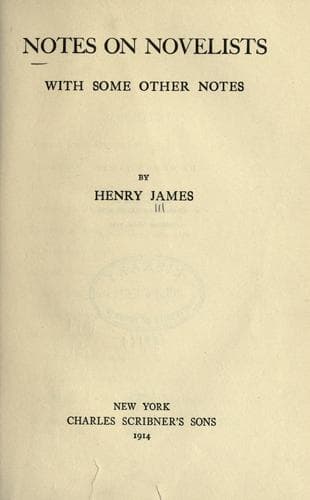
Notes on Novelists, with Some Other Notes — John Shaqi
Notes on Novelists, with Some Other NotesJames, Henry
History
Notes on Novelists, with Some Other Notes
James, Henry
Fiction -- History and criticism; Novelists
So far at any rate from growing thin for want of London he can transmit
to London or to its neighbourhood communications such as it would scarce
know otherwise where to seek. A letter to his cousin, R. A. M.
Stevenson, of September 1894, touches so on all things and, as he would
himself have said, so adorns them, brimming over with its happy
extravagance of thought, that, far again from our feeling Vailima, in
the light of it, to be out of the world, it strikes us that the world
has moved for the time to Vailima. There is world enough everywhere, he
quite unconsciously shows, for the individual, the right one, to be what
we call a man of it. He has, like every one not convenienced with the
pleasant back-door of stupidity, to make his account with seeing and
facing more things, seeing and facing everything, with the unrest of new
impressions and ideas, the loss of the fond complacencies of youth.
But as I go on in life, day by day, I become more of a
bewildered child; I cannot get used to this world, to
procreation, to heredity, to sight, to hearing; the commonest
things are a burthen. The prim obliterated polite face of life,
and the broad, bawdy and orgiastic—or mænadic—foundations,
form a spectacle to which no habit reconciles me; and “I could
wish my days to be bound each to each” by the same open-mouthed
wonder. They _are_ anyway, and whether I wish it or not. . . . I
remember very well your attitude to life—this conventional
surface of it. You have none of that curiosity for the social
stage directions, the trivial _ficelles_ of the business; it is
simian; but that is how the wild youth of man is captured.
The whole letter is enchanting.
But no doubt there is something great in the half success that
has attended the effort of turning into an emotional region Bald
Conduct without any appeal, or almost none, to the figurative,
mysterious and constitutive facts of life. Not that conduct is
not constitutive, but dear! it’s dreary! On the whole, conduct
is better dealt with on the cast-iron “gentleman” and duty
formula, with as little fervour and poetry as possible; stoical
and short.
The last letter of all, it will have been abundantly noted, has, with
one of those characteristically thrown-out references to himself that
were always half a whim, half a truth and all a picture, a remarkable
premonition. It is addressed to Mr. Edmond Gosse.
Public-domain text, read in full here on John Shaqi.
Reviews
Reviews
No reviews yet
Be the first to share your thoughts on this work.
Join the Discussion
Join the discussion
Sign in to leave a comment or review.
Sign InorCreate an account