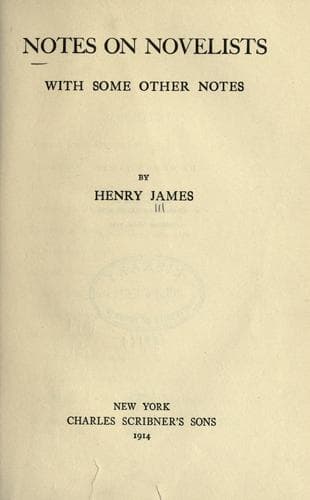
Notes on Novelists, with Some Other NotesJames, Henry
History
Notes on Novelists, with Some Other Notes
James, Henry
Fiction -- History and criticism; Novelists
This means accordingly, we submit, that those of us who at the present
hour “feel the change,” as the phrase is, in the computation of the
feminine range, with the fullest sense of what it may portend, shirk at
once our opportunity and our obligation in not squeezing for its last
drop of testimony such an exceptional body of illustration as we here
possess. It has so much to say to any view—whether, in the light of old
conventions, the brightest or the darkest—of what may either glitter or
gloom in a conquest of every license by our contemporaries of the
contending sex, that we scarce strain a point in judging it a provision
of the watchful fates for this particular purpose and profit: its
answers are so full to most of our uncertainties. It is to be noted of
course that the creator of Lélia and of Mauprat was on the one hand a
woman of an extraordinary gift and on the other a woman resignedly and
triumphantly voteless—doing without that boon so beautifully, for free
development and the acquisition and application of “rights,” that we
seem to see her sardonically smile, before our present tumults, as at a
rumpus about nothing; as if women need set such preposterous machinery
in motion for obtaining things which she had found it of the first
facility, right and left, to stretch forth her hand and take. There it
is that her precedent stands out—apparently to a blind generation; so
that some little insistence on the method of her appropriations would
seem to be peculiarly in place. It was a method that may be summed up
indeed in a fairly simple, if comprehensive, statement: it consisted in
her dealing with life exactly as if she had been a man—exactly not
being too much to say. Nature certainly had contributed on her behalf to
this success; it had given her a constitution and a temperament, the
kind of health, the kind of mind, the kind of courage, that might most
directly help—so that she had but to convert these strong matters into
the kind of experience. The writer of these lines remembers how a
distinguished and intimate friend of her later years, who was a very
great admirer, said of her to him just after her death that her not
having been born a man seemed, when one knew her, but an awkward
accident: she had been to all intents and purposes so fine and frank a
specimen of the sex. This anomalous native turn, it may be urged, can
have no general application—women cannot be men by the mere trying or
by calling themselves “as good”; they must have been provided with what
we have just noted as the outfit. The force of George Sand’s exhibition
consorts, we contend, none the less perfectly with the logic of the
consummation awaiting us, if a multitude of signs are to be trusted, in
a more or less near future: that effective repudiation of the
_distinctive_, as to function and opportunity, as to working and playing
activity, for which the definite removal of immemorial disabilities is
but another name.
Public-domain text, read in full here on John Shaqi.
Reviews
Reviews
No reviews yet
Be the first to share your thoughts on this work.
Elsewhere in the archive
Join the Discussion
Join the discussion
Sign in to leave a comment or review.
Sign InorCreate an account