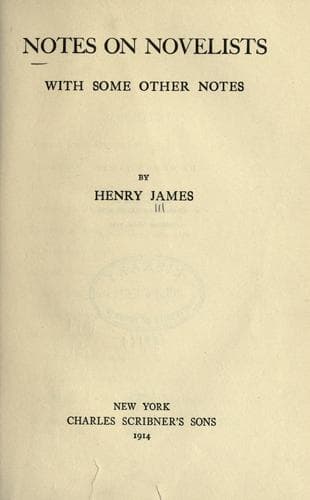
Notes on Novelists, with Some Other NotesJames, Henry
History
Notes on Novelists, with Some Other Notes
James, Henry
Fiction -- History and criticism; Novelists
from a circle still less edifying, was thus made a companion of the son
and the daughter of the house, and was especially held to compare with
the latter to her great advantage in the matter of character, docility
and temper. These young persons formed, as it were, with his more
distinguished friend, the virtual family of Chopin during those years of
specifically qualified domestication which affect us as only less of a
mystification to taste than that phase of the unrestricted which had
immediately preceded them. Hence a tangled tissue of relations within
the circle that became, as it strikes us, indescribable for difficulty
and “delicacy,” not to say for the perfection of their impracticability,
and as to which the great point is that Madame Sand’s having taken them
so robustly for granted throws upon her temperamental genius a more
direct light than any other. The whole case belongs doubtless even more
to the hapless history of Chopin himself than to that of his terrible
friend—terrible for her power to flourish in conditions sooner or later
fatal to weaker vessels; but is in addition to this one of the most
striking illustrations possible of that view or theory of social life
handed over to the reactions of sensibility almost alone which, while
ever so little the ideal of the Anglo-Saxon world, has largely governed
the manners of its sister societies. It has been our view, very
emphatically, in general, that the sane and active social body—or, for
that matter, the sane and active individual, addressed to the natural
business of life—goes wrongly about it to _encourage_ sensibility, or
to do anything on the whole but treat it as of no prime importance; the
traps it may lay for us, however, being really of the fewest in a race
to which the very imagination of it may be said, I think, to have been
comparatively denied. The imagination of it sat irremovably, on the
other hand, and as a matter of course, at the Nohant fireside; where
indeed we find the play and the ravage chiefly interesting through our
thus seeing the delicate Chopin, whose semi-smothered appeal remains
peculiarly pathetic, all helpless and foredoomed at the centre of the
whirl. Nothing again strikes us more in the connection than the familiar
truth that interesting persons make everything that concerns them
interesting, or seldom fail to redeem from what might in another air
seem but meanness and vanity even their most compromised states and
their greatest wastes of value. Every one in the particular Nohant drama
here exposed loses by the exposure—so far as loss could be predicated
of amounts which, in general, excepting the said sensibility, were so
scant among them; every one, that is, save the ruling spirit of all,
with the extraordinary mark in her of the practical defiance of waste
and of her inevitable enrichment, for our measure, as by reflection from
the surrounding shrinkage. One of the oddest aspects of the scene is
Public-domain text, read in full here on John Shaqi.
Reviews
Reviews
No reviews yet
Be the first to share your thoughts on this work.
Elsewhere in the archive
Join the Discussion
Join the discussion
Sign in to leave a comment or review.
Sign InorCreate an account