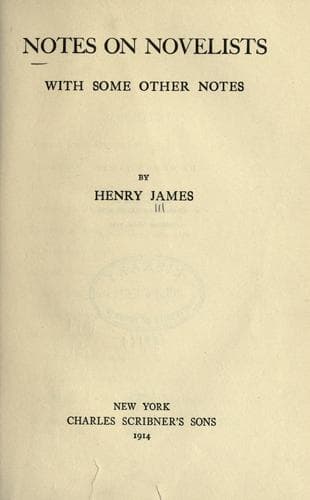
Notes on Novelists, with Some Other NotesJames, Henry
History
Notes on Novelists, with Some Other Notes
James, Henry
Fiction -- History and criticism; Novelists
Only I must immediately in this connection also add that Signor
D’Annunzio’s plays are, beside his novels, of decidedly minor weight;
testifying abundantly to his style, his romantic sense and his command
of images, but standing in spite of their eloquence only for half of his
talent, largely as he yet appears in “Il Fuoco” to announce himself by
implication as an intending, indeed as a pre-eminent dramatist. The
example is interesting when we catch in the fact the opportunity for
comparing with the last closeness the capacity of the two rival
canvases, as they become for the occasion, on which the picture of life
may be painted. The closeness is never so great, the comparison never so
pertinent, as when the separate efforts are but different phases of the
same talent. It is not at any rate under this juxtaposition that the
infinitely greater amplitude of portrayal resident in the novel strikes
us least. It in fact strikes us the more, in this quarter, for Signor
D’Annunzio, that his plays have been with one exception successes. We
must none the less take “Francesca” but for a success of curiosity; on
the part of the author I mean even more than on the part of the public.
It is primarily a pictorial and ingenious thing and, as a picture of
passion, takes, in the total collection, despite its felicities of
surface and arrangement, distinctly a “back seat.” Scarcely less than
its companions it overflows with the writer’s plenitude of verbal
expression, thanks to which, largely, the series will always prompt a
curiosity and even a tenderness in any reader interested precisely in
this momentous question of “style in a play”—interested in particular
to learn by what esthetic chemistry a play would as a work of art
propose to eschew it. It is in any such connection so inexpugnable that
we have only to be cheated of it in one place to feel the subject cry
aloud for it, like a sick man forsaken, in another.
Public-domain text, read in full here on John Shaqi.
Reviews
Reviews
No reviews yet
Be the first to share your thoughts on this work.
Elsewhere in the archive
Join the Discussion
Join the discussion
Sign in to leave a comment or review.
Sign InorCreate an account