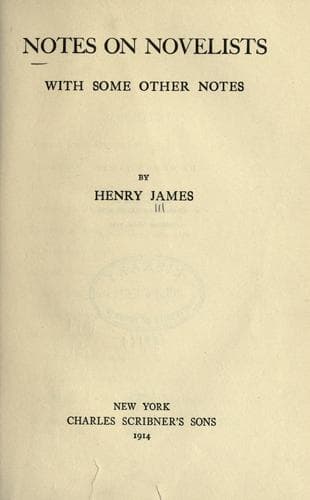
Notes on Novelists, with Some Other NotesJames, Henry
History
Notes on Novelists, with Some Other Notes
James, Henry
Fiction -- History and criticism; Novelists
These, however, are for the moment side-issues; what is more relevant is
the stride taken by our author’s early progress in his first novel and
his second, “Il Piacere” and “L’Innocente”; a pair from the freshness,
the direct young energy of which he was, for some of his admirers, too
promptly and to markedly to decline. We may take it as characteristic of
the intensity of the literary life in him that his brief career falls
already thus into periods and supplies a quantity of history sufficient
for those differences among students by which the dignity of history
appears mainly to be preserved. The nature of his prime inspiration I
have already glanced at; and we are helped to a characterisation if I
say that the famous enthroned “beauty” which operates here, so straight,
as the great obsession, is not in any perceptible degree moral beauty.
It would be difficult perhaps to find elsewhere in the same compass so
much expression of the personal life resting so little on any picture of
the personal character and the personal will. It is not that Signor
D’Annunzio has not more than once pushed his furrow in this latter
direction; but nothing is exactly more interesting, as we shall see,
than the seemingly inevitable way in which the attempt falls short.
“Il Piacere,” the first in date of the five tales, has, though with
imperfections, the merit of giving us strongly at the outset the
author’s scale and range of view, and of so constituting a sort of
prophetic summary of his elements. All that is done in the later things
is more or less done here, and nothing is absent here that we are not
afterwards also to miss. I propose, however, that it shall not be
prematurely a question with us of what we miss; no intelligible
statement of which, for that matter, in such considerations as these, is
ever possible till there has been some adequate statement of what we
find. Count Andrea Sperelli is a young man who pays, pays heavily, as we
take it that we are to understand, for an unbridled surrender to the
life of the senses; whereby it is primarily a picture of that life that
the story gives us. He is represented as inordinately, as quite
monstrously, endowed for the career that from the first absorbs and that
finally is to be held, we suppose, to engulf him; and it is a tribute to
the truth with which his endowment is presented that we should scarce
know where else to look for so complete and convincing an account of
such adventures. Casanova de Seingalt is of course infinitely more
copious, but his autobiography is cheap loose journalism compared with
the directed, finely-condensed iridescent epic of Count Andrea.
Public-domain text, read in full here on John Shaqi.
Reviews
Reviews
No reviews yet
Be the first to share your thoughts on this work.
Elsewhere in the archive
Join the Discussion
Join the discussion
Sign in to leave a comment or review.
Sign InorCreate an account