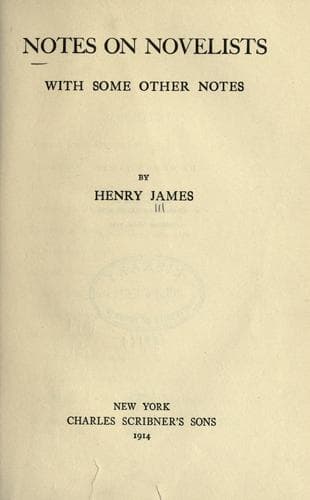
Notes on Novelists, with Some Other NotesJames, Henry
History
Notes on Novelists, with Some Other Notes
James, Henry
Fiction -- History and criticism; Novelists
This young man’s years have run but half their course from twenty to
thirty when he meets and becomes entangled with a woman more infernally
expert even than himself in the matters in which he is most expert—and
he is given us as a miracle of social and intellectual
accomplishment—the effect of whom is fatally to pervert and poison his
imagination. As his imagination is applied exclusively to the
employments of “love,” this means, for him, a frustration of all
happiness, all comfortable consistency, in subsequent relations of the
same order. The author’s view—this is fundamental—is all of a world in
which relations of any other order whatever mainly fail to offer
themselves in any attractive form. Andrea Sperelli, loving,
accordingly—in the manner in which D’Annunzio’s young men love and to
which we must specifically return—a woman of good faith, a woman as
different as possible from the creature of evil communications, finds
the vessel of his spirit itself so infected and disqualified that it
falsifies and dries up everything that passes through it. The idea that
has virtually determined the situation appears in fact to be that the
hero _would_ have loved in another manner, or would at least have wished
to, but that he had too promptly put any such fortune, so far as his
capacity is concerned, out of court. We have our reasons, presently
manifest, for doubting the possibility itself; but the theory has
nevertheless given its direction to the fable.
For the rest the author’s three sharpest signs are already unmistakable:
first his rare notation of states of excited sensibility; second his
splendid visual sense, the quick generosity of his response to the
message, as we nowadays say, of aspects and appearances, to the beauty
of places and things; third his ample and exquisite style, his curious,
various, inquisitive, always active employment of language as a means of
communication and representation. So close is the marriage between his
power of “rendering,” in the light of the imagination, and whatever he
sees and feels, that we should much mislead in speaking of his manner as
a thing distinct from the matter submitted to it. The fusion is complete
and admirable, so that, though his work is nothing if not “literary,” we
see at no point of it where literature or where life begins or ends: we
swallow our successive morsels with as little question as we swallow
food that has by proper preparation been reduced to singleness of
savour. It is brought home to us afresh that there is no complete
creation without style any more than there is complete music without
sound; also that when language becomes as closely applied and impressed
a thing as for the most part in the volumes before us the fact of
artistic creation is registered at a stroke. It is never more present
than in the thick-sown illustrative images and figures that fairly bloom
under D’Annunzio’s hand. I find examples in “Il Piacere,” as elsewhere,
by simply turning the pages.
Public-domain text, read in full here on John Shaqi.
Reviews
Reviews
No reviews yet
Be the first to share your thoughts on this work.
Elsewhere in the archive
Join the Discussion
Join the discussion
Sign in to leave a comment or review.
Sign InorCreate an account