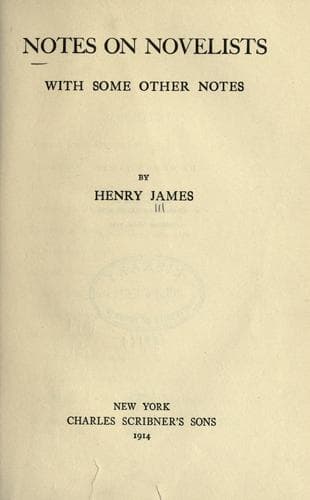
Notes on Novelists, with Some Other NotesJames, Henry
History
Notes on Novelists, with Some Other Notes
James, Henry
Fiction -- History and criticism; Novelists
For the pangs and pities of the flesh in especial D’Annunzio has in all
his work the finest hand—those of the spirit exist with him indeed only
as proceeding from these; so that Giuliana for instance affects us,
beyond any figure in fiction we are likely to remember, as living and
breathing under our touch and before our eyes, as a creature of organs,
functions and processes, palpable, audible, pitiful physical conditions.
These are facts, many of them, of an order in pursuit of which many a
spectator of the “picture of life” will instinctively desire to stop
short, however great in general his professed desire to enjoy the
borrowed consciousness that the picture of life gives us; and nothing,
it may well be said, is more certain than that we have a right in such
matters to our preference, a right to choose the kind of adventure of
the imagination we like best. No obligation whatever rests on us in
respect to a given kind—much light as our choice may often throw for
the critic on the nature of our own intelligence. _There_ at any rate,
we are disposed to say of such a piece of penetration as “L’Innocente,”
there is a particular dreadful adventure, as large as life, for those
who can bear it. The conditions are all present; it is only the reader
himself who may break down. When in general, it may be added, we see
readers do so, this is truly more often because they are shocked at
really finding the last consistency than because they are shocked at
missing it.
“Il Trionfo della Morte” and “Il Fuoco” stand together as the amplest
and richest of our author’s histories, and the earlier, and more rounded
and faultless thing of the two, is not unlikely to serve, I should
judge, as an unsurpassable example of his talent. His accomplishment
here reaches its maximum; all his powers fight for him; the wealth of
his expression drapes the situation represented in a mantle of
voluminous folds, stiff with elaborate embroidery. The “story” may be
told in three words: how Giorgio Aurispa meets in Rome the young and
extremely pretty wife of a vulgar man of business, her unhappiness with
whom is complete, and, falling in love with her on the spot, eventually
persuades her—after many troubled passages—to come and pass a series
of weeks with him in a “hermitage” by the summer sea, where, in a
delirium of free possession, he grows so to hate her, and to hate
himself for his subjection to her, and for the prostration of all honour
and decency proceeding from it, that his desire to destroy her even at
the cost of perishing with her at last takes uncontrollable form and he
drags her, under a pretext, to the edge of a sea-cliff and hurls her,
interlocked with him in appalled resistance, into space. We get at an
early stage the note of that aridity of agitation in which the narrator
has expended treasures of art in trying to interest us. “Fits of
indescribable fury made them try which could torture each other best,
Public-domain text, read in full here on John Shaqi.
Reviews
Reviews
No reviews yet
Be the first to share your thoughts on this work.
Elsewhere in the archive
Join the Discussion
Join the discussion
Sign in to leave a comment or review.
Sign InorCreate an account