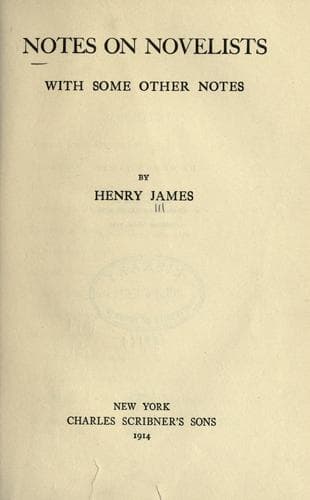
Notes on Novelists, with Some Other NotesJames, Henry
History
Notes on Novelists, with Some Other Notes
James, Henry
Fiction -- History and criticism; Novelists
which most lacerate the other’s heart and keep it in martyrdom.” But
they understand, at least the hero does; and he formulates for his
companion the essence of their _impasse_. It is not her fault when she
tears and rends.
Each human soul carries in it for love but a determinate
quantity of sensitive force. It is inevitable that this quantity
should use itself up with time, as everything else does; so that
when it _is_ used up no effort has power to prevent love from
ceasing. Now it’s a long time that you have been loving me;
nearly two years!
The young man’s intelligence is of the clearest; the woman’s here is
inferior, though in “Il Fuoco” the two opposed faculties are almost
equal; but the pair are alike far from living in their intelligence,
which only serves to bestrew with lurid gleams the black darkness of
their sensual life. So far as the intelligence is one with the will our
author fundamentally treats it as cut off from all communication with
any other quarter—that is with the senses arrayed and encamped. The
most his unfortunates arrive at is to carry their extremely embellished
minds with them through these dusky passages as a kind of gilded
glimmering lantern, the effect of which is merely fantastic and
ironic—a thing to make the play of their shadows over the walls of
their catacomb more monstrous and sinister. Again in the first pages of
“Il Trionfo” the glimmer is given.
He recognised the injustice of any resentment against her,
because he recognised the fatal necessities that controlled them
alike. No, his misery came from no other human creature; it came
from the very essence of life. The lover had not the lover to
complain of, but simply love itself. Love, toward which his
whole being reached out, from within, with a rush not to be
checked, love was of all the sad things of this earth the most
lamentably sad. And to this supreme sadness he was perhaps
condemned till death.
Public-domain text, read in full here on John Shaqi.
Reviews
Reviews
No reviews yet
Be the first to share your thoughts on this work.
Elsewhere in the archive
Join the Discussion
Join the discussion
Sign in to leave a comment or review.
Sign InorCreate an account