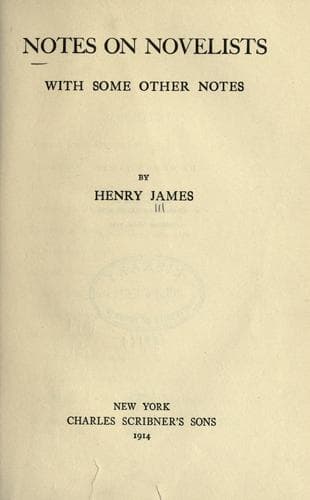
Notes on Novelists, with Some Other NotesJames, Henry
History
Notes on Novelists, with Some Other Notes
James, Henry
Fiction -- History and criticism; Novelists
That, in a nutshell, is D’Annunzio’s subject-matter; not simply that his
characters see in advance what love is worth for them, but that they
nevertheless need to make it the totality of their consciousness. In “Il
Trionfo” and “Il Fuoco” the law just expressed is put into play at the
expense of the woman, with the difference, however, that in the latter
tale the woman perceives and judges, suffers in mind, so to speak, as
well as in nerves and in temper. But it would be hard to say in which of
these two productions the inexhaustible magic of Italy most helps the
effect, most hangs over the story in such a way as to be one with it and
to make the ugliness and the beauty melt together. The ugliness, it is
to be noted, is continually _presumed_ absent; the pursuit and
cultivation of beauty—that fruitful preoccupation which above all, I
have said, gives the author his value as our “case”—being the very
ground on which the whole thing rests. The ugliness is an accident, a
treachery of fate, the intrusion of a foreign substance—having for the
most part in the scheme itself no admitted inevitability. Against it
every provision is made that the most developed taste in the world can
suggest; for, ostensibly, transcendently, Signor D’Annunzio’s _is_ the
most developed taste in the world—his and that of the ferocious yet so
contracted _conoscenti_ his heroes, whose virtual identity with himself,
affirmed with a strangely misplaced complacency by some of his critics,
one would surely hesitate to take for granted. It is the wondrous
physical and other endowments of the two heroines of “Il Piacere,” it is
the joy and splendour of the hero’s intercourse with them, to say
nothing of the lustre of his own person, descent, talents, possessions,
and of the great general setting in which everything is offered us—it
is all this that makes up the picture, with the constant suggestion that
nothing of a baser quality for the esthetic sense, or at the worst for a
pampered curiosity, might hope so much as to live in it. The case is the
same in “L’Innocente,” a scene all primarily smothered in flowers and
fruits and fragrances and soft Italian airs, in every implication of
flattered embowered constantly-renewed desire, which happens to be a
blighted felicity only for the very reason that the cultivation of
delight—in the form of the wife’s luckless experiment—has so awkwardly
overleaped itself. Whatever furthermore we may reflectively think either
of the Ippolita of “Il Trionfo” or of her companion’s scheme of
existence with her, it is enchanting grace, strange, original,
irresistible in kind and degree, that she is given us as representing;
just as her material situation with her young man during the greater
part of the tale is a constant communion, for both of them, with the
poetry and the nobleness of classic landscape, of nature consecrated by
association.
Public-domain text, read in full here on John Shaqi.
Reviews
Reviews
No reviews yet
Be the first to share your thoughts on this work.
Elsewhere in the archive
Join the Discussion
Join the discussion
Sign in to leave a comment or review.
Sign InorCreate an account