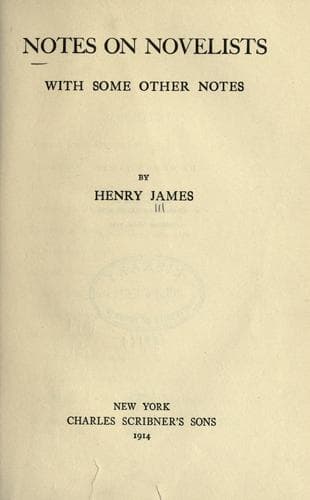
Notes on Novelists, with Some Other NotesJames, Henry
History
Notes on Novelists, with Some Other Notes
James, Henry
Fiction -- History and criticism; Novelists
That matters little indeed, as I say, while we read; the two
sensibilities concerned bloom, in all the Venetian glow, like wondrous
water-plants, throwing out branches and flowers of which we admire the
fantastic growth even while we remain, botanically speaking, bewildered.
They are other sensibilities than those with which we ourselves have
community—one of the main reasons of their appearing so I shall
presently explain; and, besides, they are isolated, sequestrated,
according to D’Annunzio’s constant view of such cases, for an exclusive,
an intensified and arid development. The mistress has, abnormally, none
of the protection, the alternative life, the saving sanity of other
interests, ties, employments; while the hero, a young poet and dramatist
with an immense consciousness of genius and fame, has for the time at
least only those poor contacts with existence that the last intimacies
of his contact with his friend’s person, her poor _corpo non più
giovane_, as he so frequently repeats, represent for him. It is not for
us, however, to contest the relation; it is in the penetrating way again
in which the relation is rendered that the writer has his triumph; the
way above all in which the world-weary interesting sensitive woman, with
her infinite intelligence, yet with her longing for some happiness still
among all her experiments untasted, and her genius at the same time for
familiar misery, is marked, featured, individualised for us, and, with
the strangest art in the world—one of those mysteries of which great
talents alone have the trick—at once ennobled with beauty and
desecrated by a process that we somehow feel to be that of exposure, to
spring from some violation of a privilege. “ ‘Do with me,’ ” says the
Foscarina on a certain occasion, “ ‘whatever you will’; and she smiled
in her offered abjection. She belonged to him like the thing one holds
in one’s fist, like the ring on one’s finger, like a glove, like a
garment, like a word that may be spoken or not, like a draught that may
be drunk or poured on the ground.” There are some lines describing an
hour in which she has made him feel as never before “the incalculable
capacity of the heart of man. And it seemed to him as he heard the
beating of his own heart and divined the violence of the other beside
him that he had in his ears the loud repercussion of the hammer on the
hard anvil where human destiny is forged.” More than ever here the pitch
of the personal drama is taken up by everything else in the
scene—everything else being in fact but the immediate presence of
Venice, her old faded colour and old vague harmonies, played with
constantly as we might play with some rosy fretted faintly-sounding
sea-shell.
Public-domain text, read in full here on John Shaqi.
Reviews
Reviews
No reviews yet
Be the first to share your thoughts on this work.
Elsewhere in the archive
Join the Discussion
Join the discussion
Sign in to leave a comment or review.
Sign InorCreate an account