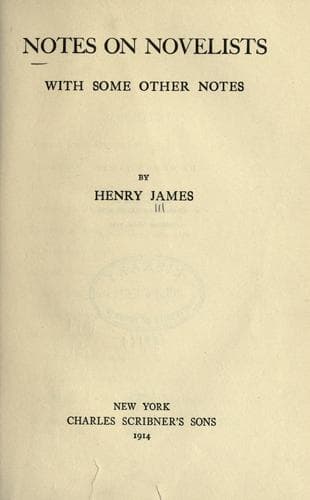
Notes on Novelists, with Some Other NotesJames, Henry
History
Notes on Novelists, with Some Other Notes
James, Henry
Fiction -- History and criticism; Novelists
It was the happy fortune of Robert Louis Stevenson to have created
beyond any man of his craft in our day a body of readers inspired with
the feelings that we for the most part place at the service only of
those for whom our affection is personal. There was no one who knew the
man, one may safely assert, who was not also devoted to the
writer—conforming in this respect to a general law (if law it be) that
shows us many exceptions; but, naturally and not inconveniently, it had
to remain far from true that all devotees of the writer were able to
approach the man. The case was nevertheless that the man somehow
approached _them_, and that to read him—certainly to read him with the
full sense of his charm—came to mean for many persons much the same as
to “meet” him. It was as if he wrote himself outright and altogether,
rose straight to the surface of his prose, and still more of his
happiest verse; so that these things gave out, besides whatever else,
his look and motions and voice, showed his life and manners, all that
there was of him, his “tremendous secrets” not excepted. We grew in
short to possess him entire, and the example is the more curious and
beautiful as he neither made a business of “confession” nor cultivated
most those forms through which the _ego_ shines. His great successes
were supposititious histories of persons quite different from himself,
and the objective, as we have learned to call it, was the ideal to which
he oftenest sacrificed.
The effect of it all none the less was such that his Correspondence has
only seemed to administer delightfully a further push to a door already
half open and through which we enter with an extraordinary failure of
any sense of intrusion. We feel indeed that we are living with him, but
what is that but what we were doing before? Through his Correspondence
certainly the _ego_ does, magnificently, shine—which is much the best
thing that in any correspondence it can ever do. But even the “Vailima
Letters,” published by Mr. Sidney Colvin in 1895, had already both
established that and allayed our diffidence. “It came over me the other
day suddenly that this diary of mine to you would make good pickings
after I am dead, and a man could make some kind of book out of it
without much trouble. So, for God’s sake, don’t lose them.”
Public-domain text, read in full here on John Shaqi.
Reviews
Reviews
No reviews yet
Be the first to share your thoughts on this work.
Join the Discussion
Join the discussion
Sign in to leave a comment or review.
Sign InorCreate an account