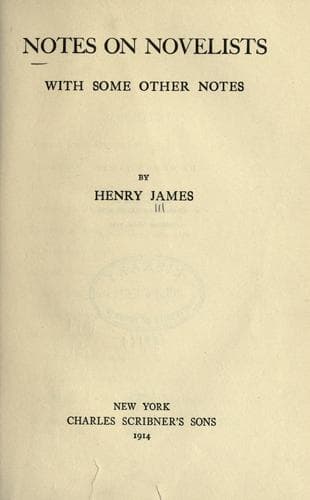
Notes on Novelists, with Some Other NotesJames, Henry
History
Notes on Novelists, with Some Other Notes
James, Henry
Fiction -- History and criticism; Novelists
Being on these terms with our author, and feeling as if we had always
been, we profit by freedoms that seem but the consecration of intimacy.
Not only have we no sense of intrusion, but we are so prepared to
penetrate further that when we come to limits we quite feel as if the
story were mutilated and the copy not complete. There it is precisely
that we seize the secret of our tie. Of course it was personal, for how
did it operate in any connection whatever but to make us live with him?
We had lived with him in “Treasure Island,” in “Kidnapped” and in
“Catriona,” just as we do, by the light of these posthumous volumes, in
the South Seas and at Vailima; and our present confidence comes from the
fact of a particularly charming continuity. It is not that his novels
were “subjective,” but that his life was romantic, and in the very same
degree in which his own conception, his own presentation, of that
element touches and thrills. If we want to know even more it is because
we are always and everywhere in the story.
To this absorbing extension of the story then the two volumes of
Letters[1] now published by Mr. Sidney Colvin beautifully contribute.
The shelf of our library that contains our best letter-writers is
considerably furnished, but not overcrowded, and its glory is not too
great to keep Stevenson from finding there a place with the very first.
He will not figure among the writers—those apt in this line to enjoy
precedence—to whom only small things happen and who beguile us by
making the most of them; he belongs to the class who have both matter
and manner, substance and spirit, whom life carries swiftly before it
and who signal and communicate, not to say gesticulate, as they go. He
lived to the topmost pulse, and the last thing that could happen was
that he should find himself on any occasion with nothing to report. Of
all that he may have uttered on certain occasions we are inevitably not
here possessed—a fact that, as I have hinted above, affects us,
perversely, as an inexcusable gap in the story; but he never fails of
the thing that we most love letters for, the full expression of the
moment and the mood, the actual good or bad or middling, the thing in
his head, his heart or his house. Mr. Colvin has given us an admirable
“Introduction”—a characterisation of his friend so founded at once on
knowledge and on judgment that the whole sense of the man strikes us as
extracted in it. He has elucidated each group or period with notes that
leave nothing to be desired; and nothing remains that I can think of to
thank him for unless the intimation that we may yet look for another
volume—which, however much more free it might make us of the author’s
mystery, we should accept, I repeat, with the same absence of scruple.
Nothing more belongs to our day than this question of the inviolable, of
the rights of privacy and the justice of our claim to aid from editors
and other retailers in getting behind certain eminent or defiant
Public-domain text, read in full here on John Shaqi.
Reviews
Reviews
No reviews yet
Be the first to share your thoughts on this work.
Join the Discussion
Join the discussion
Sign in to leave a comment or review.
Sign InorCreate an account