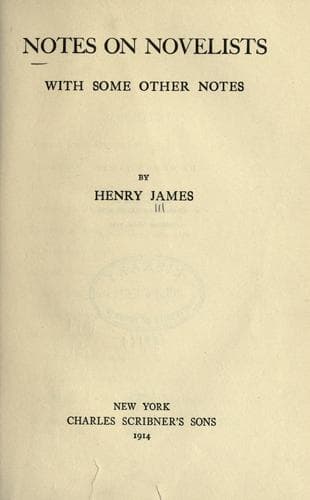
Notes on Novelists, with Some Other NotesJames, Henry
History
Notes on Novelists, with Some Other Notes
James, Henry
Fiction -- History and criticism; Novelists
Was it this element that fixed the claim even for
Byron? It seems doubtful; and the list at all events as we approach our
own day shortens and stops. Stevenson has it at present—may we not
say?—pretty well to himself, and it is not one of the scrolls in which
he least will live.
-----
Footnote 1:
“The Letters of Robert Louis Stevenson to his Family and Friends.
Selected and Edited, with Notes and Introduction, by Sidney Colvin,”
1899.
ÉMILE ZOLA
If it be true that the critical spirit to-day, in presence of the rising
tide of prose fiction, a watery waste out of which old standards and
landmarks are seen barely to emerge, like chimneys and the tops of trees
in a country under flood—if it be true that the anxious observer, with
the water up to his chin, finds himself asking for the _reason_ of the
strange phenomenon, for its warrant and title, so we likewise make out
that these credentials rather fail to float on the surface. We live in a
world of wanton and importunate fable, we breathe its air and consume
its fruits; yet who shall say that we are able, when invited, to account
for our preferring it so largely to the world of fact? To do so would be
to make some adequate statement of the good the product in question does
us. What does it do for our life, our mind, our manners, our
morals—what does it do that history, poetry, philosophy may not do, as
well or better, to warn, to comfort and command the countless thousands
for whom and by whom it comes into being? We seem too often left with
our riddle on our hands. The lame conclusion on which we retreat is that
“stories” are multiplied, circulated, paid for, on the scale of the
present hour, simply because people “like” them. As to why people
_should_ like anything so loose and mean as the preponderant mass of the
“output,” so little indebted for the magic of its action to any mystery
in the making, is more than the actual state of our perceptions enables
us to say.
Public-domain text, read in full here on John Shaqi.
Reviews
Reviews
No reviews yet
Be the first to share your thoughts on this work.
Join the Discussion
Join the discussion
Sign in to leave a comment or review.
Sign InorCreate an account