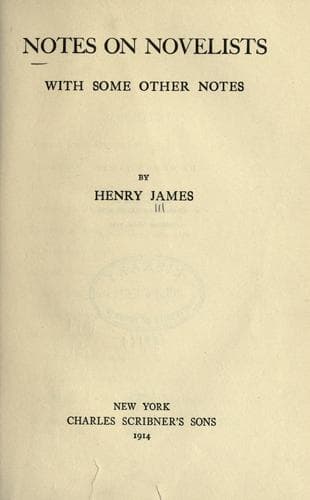
Notes on Novelists, with Some Other NotesJames, Henry
History
Notes on Novelists, with Some Other Notes
James, Henry
Fiction -- History and criticism; Novelists
of their common ancestors now dead, of their rude wars composed,
their weapons buried with them, and of these strange
changelings, their descendants, who lingered a little in their
places and would soon be gone also, and perhaps sung of by
others at the gloaming hour. By one of the unconscious arts of
tenderness the two women were enshrined together in his memory.
Tears, in that hour of sensibility, came into his eyes
indifferently at the thought of either; and the girl, from being
something merely bright and shapely, was caught up into the zone
of things serious as life and death and his dead mother. So
that, in all ways and on either side, Fate played his game
artfully with this poor pair of children. The generations were
prepared, the pangs were made ready, before the curtain rose on
the dark drama.
It is not a tribute that Stevenson would at all have appreciated, but I
may not forbear noting how closely such a page recalls many another in
the tenderest manner of Pierre Loti. There would not, compared, be a pin
to choose between them. How, we at all events ask ourselves as we
consider “Weir,” could he have kept it up?—while the reason for which
he didn’t reads itself back into his text as a kind of beautiful rash
divination in him that he mightn’t have to. Among prose fragments it
stands quite alone, with the particular grace and sanctity of mutilation
worn by the marble morsels of masterwork in another art. This and the
other things of his best he left; but these things, lovely as, on
rereading many of them at the suggestion of his Correspondence, they
are, are not the whole, nor more than the half, of his abiding charm.
The finest papers in “Across the Plains,” in “Memories and Portraits,”
in “Virginibus Puerisque,” stout of substance and supremely silver of
speech, have both a nobleness and a nearness that place them, for
perfection and roundness, above his fictions, and that also may well
remind a vulgarised generation of what, even under its nose, English
prose can be. But it is bound up with his name, for our wonder and
reflection, that he is something other than the author of this or that
particular beautiful thing, or of all such things together. It has been
his fortune (whether or no the greatest that can befall a man of
letters) to have had to consent to become, by a process not purely
mystic and not wholly untraceable—what shall we call it?—a Figure.
Tracing is needless now, for the personality has acted and the
incarnation is full. There he is—he has passed ineffaceably into happy
legend. This case of the figure is of the rarest and the honour surely
of the greatest. In all our literature we can count them, sometimes with
the work and sometimes without. The work has often been great and yet
the figure _nil_. Johnson was one, and Goldsmith and Byron; and the two
former moreover not in any degree, like Stevenson, in virtue of the
element of grace.
Public-domain text, read in full here on John Shaqi.
Reviews
Reviews
No reviews yet
Be the first to share your thoughts on this work.
Join the Discussion
Join the discussion
Sign in to leave a comment or review.
Sign InorCreate an account