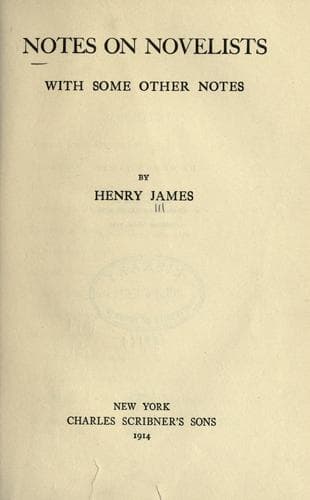
Notes on Novelists, with Some Other NotesJames, Henry
History
Notes on Novelists, with Some Other Notes
James, Henry
Fiction -- History and criticism; Novelists
desire on the author’s part to impute a “value” defeated by his
apparently not knowing what a value is. She is apparently an immense
value for the occasions on which the couple secretly meet, but how is
she otherwise one? and what becomes therefore of the beauty, the
interest, the pathos, the struggle, or whatever else, of her
relation—relation of character, of judgment, even of mere taste—to her
own collapse? The immediate physical sensibility that surrenders in her
is, as throughout, exquisitely painted; but since nothing operates for
her, one way or the other, _but_ that familiar faculty, we are left
casting about us almost as much for what else she has to give as for
what, in any case, she may wish to keep.
The author’s view of the whole matter of durations and dates, in these
connections, gives the scale of “distinction” by itself a marked
downward tilt; it confounds all differences between the trivial and the
grave. Giuliana, in “L’Innocente,” is interesting because she has had a
misadventure, and she is exquisite in her delineator’s view because she
has repented of it. But the misadventure, it appears, was a matter but
of a minute; so that we oddly see this particular romance attenuated on
the ground of its brevity. Given the claims of the exquisite, the
attenuation should surely be sought in the very opposite quarter; since,
where these remarkable affections are concerned, how otherwise than by
the element of comparative duration do we obtain the element of
comparative good faith, on which we depend for the element, in turn, of
comparative dignity? Andrea Sperelli becomes in the course of a few
weeks in Rome the lover of some twenty or thirty women of fashion—the
number scarce matters; but to make this possible his connection with
each has but to last a day or two; and the effect of that in its order
is to reduce to nothing, by vulgarity, by frank grotesqueness of
association, the romantic capacity in him on which his chronicler’s
whole appeal to us is based. The association rising before us more
nearly than any other is that of the manners observable in the most
mimetic department of any great menagerie.
Public-domain text, read in full here on John Shaqi.
Reviews
Reviews
No reviews yet
Be the first to share your thoughts on this work.
Elsewhere in the archive
Join the Discussion
Join the discussion
Sign in to leave a comment or review.
Sign InorCreate an account