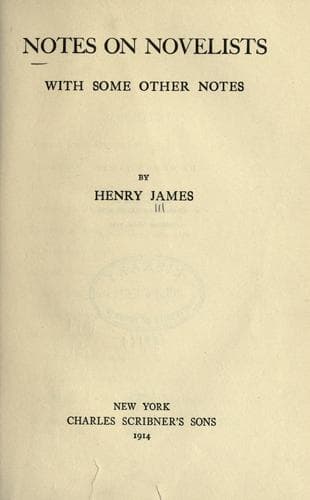
Notes on Novelists, with Some Other NotesJames, Henry
History
Notes on Novelists, with Some Other Notes
James, Henry
Fiction -- History and criticism; Novelists
The most serious relation depicted—in the sense of being in some degree
the least suggestive of mere zoological sociability—is that of the
lovers in “Il Fuoco,” as we also take this pair for their creator’s
sanest and most responsible spirits. It is a question between them of an
heroic affection, and yet the affection appears to make good for itself
no place worth speaking of in their lives. It holds but for a scant few
weeks; the autumn already reigns when the connection begins, and the
connection is played out (or if it be not the ado is about nothing) with
the first flush of the early Italian spring. It suddenly, on our hands,
becomes trivial, with all our own estimate of reasons and realities and
congruities falsified. The Foscarina has, on professional business, to
“go away,” and the young poet has to do the same; but such a separation,
so easily bridged over by such great people, makes a beggarly climax for
an intercourse on behalf of which all the forces of poetry and tragedy
have been set in motion. Where then we ask ourselves is the
weakness?—as we ask it, very much in the same way, in respect to the
vulgarised aspect of the tragedy of Giorgio Aurispa. The pang of pity,
the pang that springs from a conceivable community in doom, is in this
latter case altogether wanting. Directly we lift a little the
embroidered mantle of that gift for appearances which plays, on Signor
D’Annunzio’s part, such tricks upon us, we find ourselves put off, as
the phrase is, with an inferior article. The inferior article is the
hero’s poverty of life, which cuts him down for pathetic interest just
as the same limitation in “Il Piacere” cuts down Donna Maria. Presented
each as victims of another rapacious person who has got the better of
them, there is no process, no complexity, no suspense in their story;
and thereby, we submit, there is no esthetic beauty. Why _shouldn’t_
Giorgio Aurispa go mad? Why shouldn’t Stelio Effrena go away? We make
the inquiry as disconcerted spectators, not feeling in the former case
that we have had any communication with the wretched youth’s sanity, and
not seeing in the latter why the tie of all the passion that has been
made so admirably vivid for us should not be able to weather change.
Public-domain text, read in full here on John Shaqi.
Reviews
Reviews
No reviews yet
Be the first to share your thoughts on this work.
Elsewhere in the archive
Join the Discussion
Join the discussion
Sign in to leave a comment or review.
Sign InorCreate an account