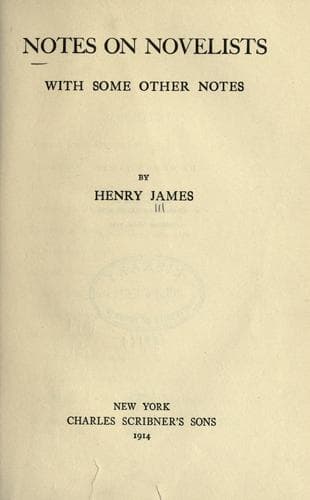
Notes on Novelists, with Some Other NotesJames, Henry
History
Notes on Novelists, with Some Other Notes
James, Henry
Fiction -- History and criticism; Novelists
Nothing is so singular with D’Annunzio as that the very basis and
subject of his work should repeatedly go aground on such shallows as
these. He takes for treatment a situation that is substantially
none—the most fundamental this of his values, and all the more
compromising that his immense art of producing illusions still leaves it
exposed. The idea in each case is superficially specious, but _where_ it
breaks down is what makes all the difference. “Il Piacere” would have
meant what it seems to try to mean only if a provision had been made in
it for some adequate “inwardness” on the part either of the nature
disintegrated or of the other nature to which this poisoned contact
proves fatal. “L’Innocente,” of the group, comes nearest to justifying
its idea; and I leave it unchallenged, though its meaning surely would
have been written larger if the attitude of the wife toward her
misbegotten child had been, in face of the husband’s, a little less that
of the dumb detached animal suffering in her simplicity. As a picture of
such suffering, the pain of the mere dumb animal, the work is indeed
magnificent; only its connections are poor with the higher dramatic, the
higher poetic, complexity of things.
I can only repeat that to make “The Triumph of Death” a fruitful thing
we should have been able to measure the triumph by its frustration of
some conceivable opportunity at least for life. There is a moment at
which we hope for something of this kind, the moment at which the young
man pays his visit to his family, who have grievous need of him and
toward whom we look to see some one side or other of his fine
sensibility turn. But nothing comes of that for the simple reason that
the personage is already dead—that nothing exists in him but the
established _fear_ of life. He turns his back on everything but a
special sensation, and so completely shuts the door on the elements of
contrast and curiosity. Death really triumphs, in the matter, but over
the physical terror of the inordinate woman; a pang perfectly
communicated to us, but too small a surface to bear the weight laid on
it, which accordingly affects us as that of a pyramid turned over on its
point. It is throughout one of D’Annunzio’s strongest marks that he
treats “love” as a matter not to be mixed with life, in the larger sense
of the word, at all—as a matter all of whose other connections are
dropped; a sort of secret game that can go on only if each of the
parties has nothing to do, even on any _other_ terms, with any one else.
Public-domain text, read in full here on John Shaqi.
Reviews
Reviews
No reviews yet
Be the first to share your thoughts on this work.
Elsewhere in the archive
Join the Discussion
Join the discussion
Sign in to leave a comment or review.
Sign InorCreate an account