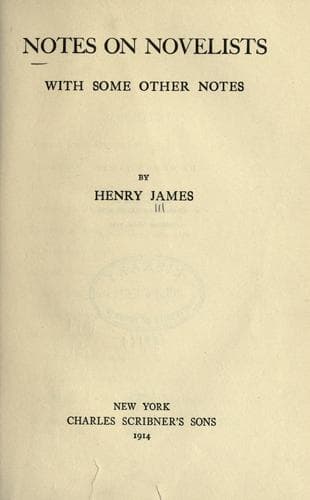
Notes on Novelists, with Some Other NotesJames, Henry
History
Notes on Novelists, with Some Other Notes
James, Henry
Fiction -- History and criticism; Novelists
I have dwelt on the fact that the sentimental intention in “Il Fuoco”
quite bewilderingly fails, in spite of the splendid accumulation of
material. We wait to the end to see it declare itself, and then are
left, as I have already indicated, with a mere meaningless anecdote on
our hands. Brilliant and free, each freighted with a talent that is
given us as incomparable, the parties to the combination depicted have,
for their affection, the whole world before them—and not the simple
terraqueous globe, but that still vaster sphere of the imagination in
which, by an exceptionally happy chance, they are able to move together
on very nearly equal terms. A tragedy is a tragedy, a comedy is a
comedy, when the effect, in either sense, is _determined_ for us,
determined by the interference of some element that starts a
complication or precipitates an action. As in “Il Fuoco” nothing
whatever interferes—or nothing certainly that need weigh with the high
spirits represented—we ask why such precious revelations are made us
for nothing. Admirably made in themselves they yet strike us as,
esthetically speaking, almost cruelly wasted.
This general remark would hold good, as well, of “Le Vergini,” if I
might still linger, though its application has already been virtually
made. Anatolia, in this tale, the most robust of the three sisters,
declines marriage in order to devote herself to a family who have, it
would certainly appear, signal need of her nursing. But this, though it
sufficiently represents _her_ situation, covers as little as possible
the ground of the hero’s own, since he, quivering intensely with the
treasure of his “will,” inherited in a straight line from the
_cinque-cento_, only asks to affirm his sublimated energy. The
temptation to affirm it erotically, at least, has been great for him in
relation to each of the young women in turn; but it is for Anatolia that
his admiration and affection most increase in volume, and it is
accordingly for her sake that, with the wonderful moral force behind him
(kept as in a Florentine casket,) we most look to see him justified. He
has a fine image—and when has the author not fine images?—to
illustrate the constant readiness of this possession. The young woman
says something that inspires him, whereupon, “as a sudden light playing
over the dusky wall of a room causes the motionless sword in a trophy to
shine, so her word drew a great flash from my suspended _volontà_. There
was a virtue in her,” the narrator adds, “which could have produced
portentous fruit. Her substance might have nourished a superhuman germ.”
In spite of which it never succeeds in becoming so much as a question
that his affection for her shall _act_, that this grand imagination in
him shall operate, that he himself is, in virtue of such things, exactly
the person to come to her aid and to combine with her in devotion. The
talk about the _volontà_ is amusing much in the same way as the
Public-domain text, read in full here on John Shaqi.
Reviews
Reviews
No reviews yet
Be the first to share your thoughts on this work.
Elsewhere in the archive
Join the Discussion
Join the discussion
Sign in to leave a comment or review.
Sign InorCreate an account