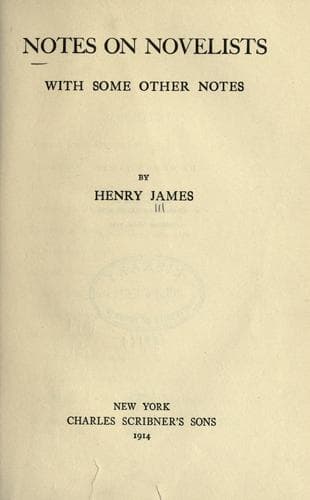
Notes on Novelists, with Some Other NotesJames, Henry
History
Notes on Novelists, with Some Other Notes
James, Henry
Fiction -- History and criticism; Novelists
complacency of a primitive man, unacquainted with the uses of things,
who becomes possessed by some accident of one of the toys of
civilisation, a watch or a motor-car. And yet artistically and for our
author the will _has_ an application, since without it he could have
done no rare vivid work.
Here at all events we put our finger, I think, on the very point at
which his esthetic plenitude meets the misadventure that discredits it.
We see just where it “joins on” with vulgarity. That sexual passion from
which he extracts such admirable detached pictures insists on remaining
for him _only_ the act of a moment, beginning and ending in itself and
disowning any representative character. From the moment it depends on
itself alone for its beauty it endangers extremely its distinction, so
precarious at the best. For what it represents, precisely, is it
poetically interesting; it finds its extension and consummation only in
the rest of life. Shut out from the rest of life, shut out from all
fruition and assimilation, it has no more dignity than—to use a homely
image—the boots and shoes that we see, in the corridors of promiscuous
hotels, standing, often in double pairs, at the doors of rooms. Detached
and unassociated these clusters of objects present, however obtruded, no
importance. What the participants do with their agitation, in short, or
even what it does with them, _that_ is the stuff of poetry, and it is
never really interesting save when something finely contributive in
themselves makes it so. It is this absence of anything finely
contributive in themselves, on the part of the various couples here
concerned, that is the open door to the trivial. I have said, with all
appreciation, that they present the great “relation,” for intimacy, as
we shall nowhere else find it presented; but to see it related, in its
own turn, to nothing in the heaven above or the earth beneath, this
undermines, we definitely learn, the charm of that achievement.
And so it is, strangely, that our esthetic “case” enlightens us. The
only question is whether it be the only case of the kind conceivable.
May we not suppose another with the elements differently mixed? May we
not in imagination alter the proportions within or the influences
without, and look with cheerfulness for a different issue? _Need_ the
esthetic adventure, in a word, organised for real discovery, give us no
more comforting news of success? Are there not, so to speak, finer
possible combinations? are there not safeguards against futility that in
the example before us were but too presumably absent? To which the sole
answer probably is that no man can say. It is Signor D’Annunzio alone
who has really sailed the sea and brought back the booty. The actual
case is so good that all the potential fade beside it. It has for it
that it exists, and that, whether for the strength of the original
outfit or for the weight of the final testimony, it could scarce
thinkably be bettered.
Public-domain text, read in full here on John Shaqi.
Reviews
Reviews
No reviews yet
Be the first to share your thoughts on this work.
Elsewhere in the archive
Join the Discussion
Join the discussion
Sign in to leave a comment or review.
Sign InorCreate an account