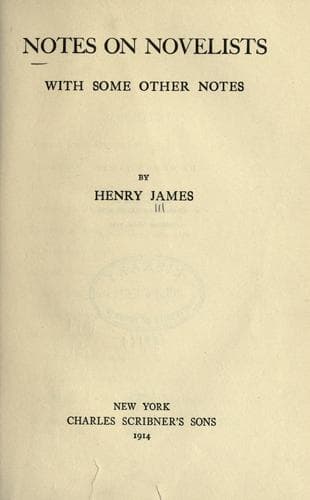
Notes on Novelists, with Some Other NotesJames, Henry
History
Notes on Novelists, with Some Other Notes
James, Henry
Fiction -- History and criticism; Novelists
which it might escape from a noisy family party or alight from a crowded
omnibus. It is at the category of the familiar that vulgarity begins.
There may be a cool virtue therefore even for “art,” and an appreciable
distinction even for truth, in the grace of hanging back and the choice
of standing off, in that shade of the superficial which we best defend
by simply practising it in season. A feeling revives at last, after a
timed intermission, that we may not immediately be quite able, quite
assured enough, to name, but which, gradually clearing up, soon defines
itself almost as a yearning. We turn round in obedience to
it—unmistakably we turn round again to the opposite pole, and there
before we know it have positively laid a clinging hand on dear old Jane
Austen.
THE NEW NOVEL
1914
We feel it not to be the paradox it may at the first blush seem that the
state of the novel in England at the present time is virtually very much
the state of criticism itself; and this moreover, at the risk perhaps of
some added appearance of perverse remark, by the very reason that we see
criticism so much in abeyance. So far as we miss it altogether how and
why does its “state” matter, and why and how can it or should it, as an
absent force, enjoy a relation to that constant renewal of our supply of
fiction which is a present one so far as a force at all? The relation is
this, in the fewest words: that no equal outpouring of matter into the
mould of literature, or what roughly passes for such, has been noted to
live its life and maintain its flood, its level at least of quantity and
mass, in such free and easy independence of critical attention. It
constitutes a condition and a perversity on the part of this element to
remain irresponsive before an appeal so vociferous at least and so
incessant; therefore how can such a neglect of occasions, so careless a
habit in spite of marked openings, be better described than as
responsibility declined in the face of disorder? The disorder thus
determines the relation, from the moment we feel that it might be less,
that it might be different, that something in the way of an order even
might be disengaged from it and replace it; from the moment in fact that
the low critical pitch is logically _reflected_ in the poetic or, less
pedantically speaking, the improvisational at large. The effect, if not
the prime office, of criticism is to make our absorption and our
enjoyment of the things that feed the mind as aware of itself as
possible, since that awareness quickens the mental demand, which thus in
turn wanders further and further for pasture. This action on the part of
the mind practically amounts to a reaching out for the reasons of its
interest, as only by its so ascertaining them can the interest grow more
various. This is the very education of our imaginative life; and thanks
to it the general question of how to refine, and of why certain things
Public-domain text, read in full here on John Shaqi.
Reviews
Reviews
No reviews yet
Be the first to share your thoughts on this work.
Elsewhere in the archive
Join the Discussion
Join the discussion
Sign in to leave a comment or review.
Sign InorCreate an account