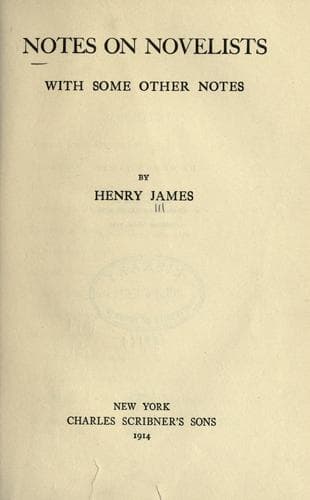
Notes on Novelists, with Some Other NotesJames, Henry
History
Notes on Novelists, with Some Other Notes
James, Henry
Fiction -- History and criticism; Novelists
refine more and most, on that happy consciousness, becomes for us of the
last importance. Then we cease to be only instinctive and at the mercy
of chance, feeling that we can ourselves take a hand in our satisfaction
and provide for it, making ourselves safe against dearth, and through
the door opened by that perception criticism enters, if we but give it
time, as a flood, the great flood of awareness; so maintaining its high
tide unless through some lapse of our sense for it, some flat reversion
to instinct alone, we block up the ingress and sit in stale and
shrinking waters. Stupidity may arrest any current and fatuity transcend
any privilege. The comfort of those who at such a time consider the
scene may be a little, with _their_ curiosity still insistent, to survey
its platitude and record the exhibited shrinkage; which amounts to the
attempt to understand how stupidity could so have prevailed. We take it
here that the answer to that inquiry can but be ever the same. The flood
of “production” has so inordinately exceeded the activity of control
that this latter anxious agent, first alarmed but then indifferent, has
been forced backward out of the gate, leaving the contents of the
reservoir to boil and evaporate. It is verily on the wrong side of the
gate that we just now seem to see criticism stand, for never was the
reservoir so bubblingly and noisily full, at least by the superficial
measure of life. We have caught the odd accident in the very fact of its
occurrence; we have seen the torrent swell by extravagant cheap
contribution, the huge increase of affluents turbid and unstrained.
Beyond number are the ways in which the democratic example, once
gathering momentum, sets its mark on societies and seasons that stand in
its course. Nowhere is that example written larger, to our perception,
than in “the new novel”; though this, we hasten to add, not in the least
because prose fiction now occupies itself as never before with the
“condition of the people,” a fact quite irrelevant to the nature it has
taken on, but because that nature amounts exactly to the complacent
declaration of a common literary level, a repudiation the most operative
even if the least reasoned of the idea of differences, the virtual law,
as we may call it, of sorts and kinds, the values of individual quality
and weight in the presence of undiscriminated quantity and
rough-and-tumble “output”—these attestations made, we naturally mean,
in the air of composition and on the esthetic plane, if such terms have
still an attenuated reference to the case before us. With which, if we
be asked, in the light of that generalisation, whether we impute to the
novel, or in other words the novelist, _all_ the stupidity against which
the spirit of appreciation spends itself in vain, we reply perforce that
we stop short of that, it being too obvious that of an exhibition so
sterilised, so void of all force and suggestion, there would be nothing
whatever to say.
Public-domain text, read in full here on John Shaqi.
Reviews
Reviews
No reviews yet
Be the first to share your thoughts on this work.
Elsewhere in the archive
Join the Discussion
Join the discussion
Sign in to leave a comment or review.
Sign InorCreate an account