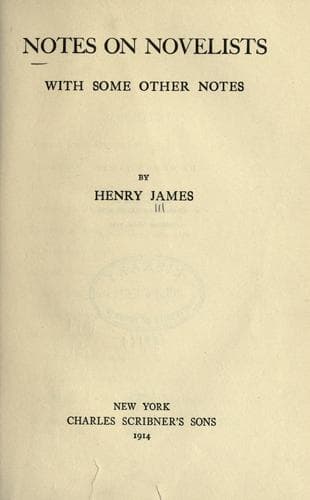
Notes on Novelists, with Some Other NotesJames, Henry
History
Notes on Novelists, with Some Other Notes
James, Henry
Fiction -- History and criticism; Novelists
Our contention is exactly that, in spite of all vain
aspects, it does yet present an interest, and that here and there seem
written on it likelihoods of its presenting still more—always on
condition of its consenting to that more intimate education which is
precisely what democratised movements look most askance at. It strikes
us as not too much to say that our actual view of the practice of
fiction gives as just a measure as could be desired of the general, the
incurable democratic suspicion of the selective and comparative
principles in almost any application, and the tendency therewith to
regard, and above all to treat, one manner of book, like one manner of
person, as, if not absolutely as good as another, yet good enough for
any democratic use. Criticism reflects contentiously on that appearance,
though it be an appearance in which comfort for the book and the manner
much resides; so that the idea prompting these remarks of our own is
that the comfort may be deeply fallacious.
I
Still not to let go of our imputation of interest to some part at least
of what is happening in the world of production in this kind, we may say
that non-selective and non-comparative practice appears bent on showing
us all it can do and how far or to what appointed shores, what waiting
havens and inviting inlets, the current that is mainly made a current by
looseness, by want of observable direction, shall succeed in carrying
it. We respond to any sign of an intelligent view or even of a lively
instinct—which is why we give the appearance so noted the benefit of
every presumption as to its life and health. It may be that the dim
sense is livelier than the presentable reason, but even that is no
graceless fact for us, especially when the keenness of young curiosity
and energy is betrayed in its pace, and betrayed, for that matter, in no
small abundance and variety. The new or at least the young novel is up
and doing, clearly, with the best faith and the highest spirits in the
world; if we but extend a little our measure of youth indeed, as we are
happily more and more disposed to, we may speak of it as already
chin-deep in trophies. The men who are not so young as the youngest were
but the other day very little older than these: Mr. Joseph Conrad, Mr.
Maurice Hewlett and Mr. Galsworthy, Mr. H. G. Wells and Mr. Arnold
Bennett, have not quite perhaps the early bloom of Mr. Hugh Walpole, Mr.
Gilbert Cannan, Mr. Compton Mackenzie and Mr. D. H. Lawrence, but the
spring unrelaxed is still, to our perception, in their step, and we see
two or three of them sufficiently related to the still newer generation
in a quasi-parental way to make our whole enumeration as illustrational
as we need it. Mr. Wells and Mr. Arnold Bennett have their strongest
mark, the aspect by which we may most classify them, in common—even if
their three named contemporaries are doubtless most interesting in one
of the connections we are not now seeking to make.
Public-domain text, read in full here on John Shaqi.
Reviews
Reviews
No reviews yet
Be the first to share your thoughts on this work.
Elsewhere in the archive
Join the Discussion
Join the discussion
Sign in to leave a comment or review.
Sign InorCreate an account