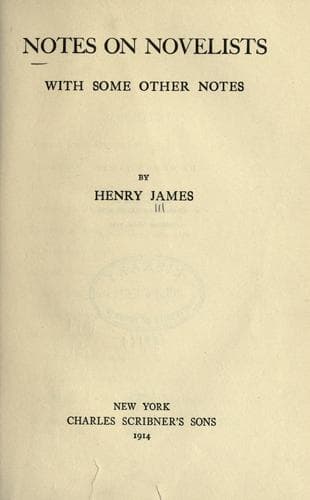
Notes on Novelists, with Some Other NotesJames, Henry
History
Notes on Novelists, with Some Other Notes
James, Henry
Fiction -- History and criticism; Novelists
to the question of application. When the author of “Clayhanger” has put
down upon the table, in dense unconfused array, every fact required,
every fact in any way invocable, to make the life of the Five Towns
press upon us, and to make our sense of it, so full-fed, content us, we
may very well go on for the time in the captive condition, the beguiled
and bemused condition, the acknowledgment of which is in general our
highest tribute to the temporary master of our sensibility. Nothing at
such moments—or rather at the end of them, when the end begins to
threaten—may be of a more curious strain than the dawning unrest that
suggests to us fairly our first critical comment: “Yes, yes—but is this
_all_? These are the circumstances of the interest—we see, we see; but
where is the interest itself, where and what is its centre, and how are
we to measure it in relation to _that_?” Of course we may in the act of
exhaling that plaint (which we have just expressed at its mildest) well
remember how many people there are to tell us that to “measure” an
interest is none of our affair; that we have but to take it on the
cheapest and easiest terms and be thankful; and that if by our very
confession we have been led the imaginative dance the music has done for
us all it pretends to. Which words, however, have only to happen to be
for us the most unintelligent conceivable not in the least to arrest our
wonderment as to where our bedrenched consciousness may still not
awkwardly leave us for the pleasure of appreciation. That appreciation
is also a mistake and a priggishness, being reflective and thereby
corrosive, is another of the fond dicta which we are here concerned but
to brush aside—the more closely to embrace the welcome induction that
appreciation, attentive and reflective, inquisitive and conclusive, is
in this connection absolutely the golden _key_ to our pleasure. The more
it plays up, the more we recognise and are able to number the sources of
our enjoyment, the greater the provision made for security in that
attitude, which corresponds, by the same stroke, with the reduced danger
of waste in the undertaking to amuse us. It all comes back to our
amusement, and to the noblest surely, on the whole, we know; and it is
in the very nature of clinging appreciation not to sacrifice
consentingly a single shade of the art that makes for that blessing.
From this solicitude spring our questions, and not least the one to
which we give ourselves for the moment here—this moment of our being
regaled as never yet with the fruits of the movement (if the name be not
of too pompous an application where the flush and the heat of accident
too seem so candidly to look forth), in favour of the “expression of
life” in terms as loose as may pretend to an effect of expression at
all. The relegation of terms to the limbo of delusions outlived so far
as ever really cultivated becomes of necessity, it will be plain, the
Public-domain text, read in full here on John Shaqi.
Reviews
Reviews
No reviews yet
Be the first to share your thoughts on this work.
Elsewhere in the archive
Join the Discussion
Join the discussion
Sign in to leave a comment or review.
Sign InorCreate an account