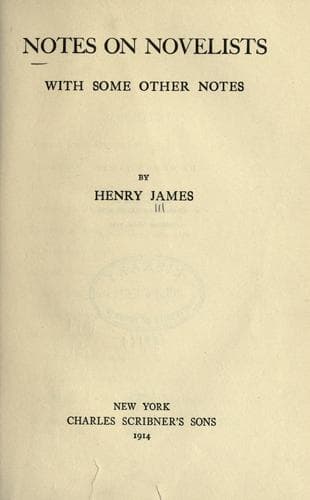
Notes on Novelists, with Some Other NotesJames, Henry
History
Notes on Novelists, with Some Other Notes
James, Henry
Fiction -- History and criticism; Novelists
What is at all events striking for us, critically speaking, is that, in
the midst of the dishonour it has gradually harvested by triumphant
vulgarity of practice, its pliancy and applicability can still plead for
themselves. The curious contradiction stands forth for our relief—the
circumstance that thirty years ago a young man of extraordinary brain
and indomitable purpose, wishing to give the measure of these endowments
in a piece of work supremely solid, conceived and sat down to Les
Rougon-Macquart rather than to an equal task in physics, mathematics,
politics or economics. He saw his undertaking, thanks to his patience
and courage, practically to a close; so that it is exactly neither of
the so-called constructive sciences that happens to have had the
benefit, intellectually speaking, of one of the few most constructive
achievements of our time. There then, provisionally at least, we touch
bottom; we get a glimpse of the pliancy and variety, the ideal of
vividness, on behalf of which our equivocal form may appeal to a strong
head. In the name of what ideal on its own side, however, does the
strong head yield to the appeal? What is the logic of its so deeply
committing itself? Zola’s case seems to tell us, as it tells us other
things. The logic is in its huge freedom of adjustment to the
temperament of the worker, which it carries, so to say, as no other
vehicle can do. It expresses fully and directly the whole man, and big
as he may be it can still be big enough for him without becoming false
to its type. We see this truth made strong, from beginning to end, in
Zola’s work; we see the temperament, we see the whole man, with his size
and all his marks, stored and packed away in the huge hold of Les
Rougon-Macquart as a cargo is packed away on a ship. His personality is
the thing that finally pervades and prevails, just as so often on a
vessel the presence of the cargo makes itself felt for the assaulted
senses. What has most come home to me in reading him over is that a
scheme of fiction so conducted is in fact a capacious vessel. It can
carry anything—with art and force in the stowage; nothing in this case
will sink it. And it is the only form for which such a claim can be
made. All others have to confess to a smaller scope—to selection, to
exclusion, to the danger of distortion, explosion, combustion. The novel
has nothing to fear but sailing too light. It will take aboard all we
bring in good faith to the dock.
Public-domain text, read in full here on John Shaqi.
Reviews
Reviews
No reviews yet
Be the first to share your thoughts on this work.
Join the Discussion
Join the discussion
Sign in to leave a comment or review.
Sign InorCreate an account