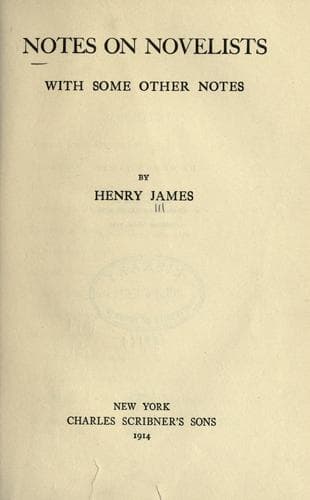
Notes on Novelists, with Some Other NotesJames, Henry
History
Notes on Novelists, with Some Other Notes
James, Henry
Fiction -- History and criticism; Novelists
An intense vision of this truth must have been Zola’s comfort from the
earliest time—the years, immediately following the crash of the Empire,
during which he settled himself to the tremendous task he had mapped
out. No finer act of courage and confidence, I think, is recorded in the
history of letters. The critic in sympathy with him returns again and
again to the great wonder of it, in which something so strange is mixed
with something so august. Entertained and carried out almost from the
threshold of manhood, the high project, the work of a lifetime,
announces beforehand its inevitable weakness and yet speaks in the same
voice for its admirable, its almost unimaginable strength. The strength
was in the young man’s very person—in his character, his will, his
passion, his fighting temper, his aggressive lips, his squared shoulders
(when he “sat up”) and overweening confidence; his weakness was in that
inexperience of life from which he proposed not to suffer, from which he
in fact suffered on the surface remarkably little, and from which he was
never to suspect, I judge, that he had suffered at all. I may mention
for the interest of it that, meeting him during his first short visit to
London—made several years before his stay in England during the Dreyfus
trial—I received a direct impression of him that was more informing
than any previous study. I had seen him a little, in Paris, years before
that, when this impression was a perceptible promise, and I was now to
perceive how time had made it good. It consisted, simply stated, in his
fairly bristling with the betrayal that nothing whatever had happened to
him in life but to write Les Rougon-Macquart. It was even for that
matter almost more as if Les Rougon-Macquart had written _him_, written
him as he stood and sat, as he looked and spoke, as the long,
concentrated, merciless effort had made and stamped and left him.
Something very fundamental was to happen to him in due course, it is
true, shaking him to his base; fate was not wholly to cheat him of an
independent evolution. Recalling him from this London hour one strongly
felt during the famous “Affair” that his outbreak in connection with it
was the act of a man with arrears of personal history to make up, the
act of a spirit for which life, or for which at any rate freedom, had
been too much postponed, treating itself at last to a luxury of
experience.
Public-domain text, read in full here on John Shaqi.
Reviews
Reviews
No reviews yet
Be the first to share your thoughts on this work.
Join the Discussion
Join the discussion
Sign in to leave a comment or review.
Sign InorCreate an account