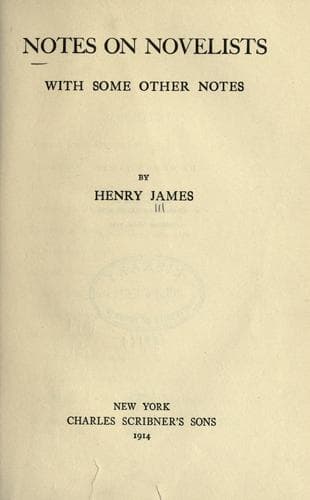
Notes on Novelists, with Some Other NotesJames, Henry
History
Notes on Novelists, with Some Other Notes
James, Henry
Fiction -- History and criticism; Novelists
composed picture), of what that composition is specifically _about_ and
where, for treatment of this interest, it undertakes to find its centre:
all of which, we are willing however to grant, falls away before the
large assurance and incorrigible levity with which this adventurer
carries his lapses—far more of an adventurer as he is than any other of
the company. The composition, as we have called it, heaven saving the
mark, is simply at any and every moment “about” Mr. Wells’s general
adventure; which is quite enough while it preserves, as we trust it will
long continue to do, its present robust pitch.
We have already noted that “Round the Corner,” Mr. Gilbert Cannan’s
liveliest appeal to our attention, belongs to the order of
_constatations_ pure and simple; to the degree that _as_ a document of
that nature and of that rigour the book could perhaps not more
completely affirm itself. When we have said that it puts on record the
“tone,” the manners, the general domestic proceedings and _train de vie_
of an amiable clergyman’s family established in one of the more sordid
quarters of a big black northern city of the Liverpool or Manchester
complexion we have advanced as far in the way of descriptive statement
as the interesting work seems to warrant. For it _is_ interesting, in
spite of its leaving itself on our hands with a consistent indifference
to any question of the charmed application springing from it all that
places it in the forefront of its type. Again as under the effect of Mr.
Bennett’s major productions our sole inference is that things, the
things disclosed, _go on and on, in any given case, in spite of
everything_—with Mr. Cannan’s one discernible care perhaps being for
how extraordinarily much, in the particular example here before him,
they were able to go on in spite of. The conception, the presentation of
this enormous inauspicious amount as bearing upon the collective career
of the Folyats is, we think, as near as the author comes at any point to
betraying an awareness of a subject. Yet again, though so little
encouraged or “backed,” a subject after a fashion makes itself, even as
it has made itself in “The Old Wives’ Tale” and in “Clayhanger,” in
“Sons and Lovers,” where, as we have hinted, any assistance rendered us
for a view of one _most_ comfortably enjoys its absence, and in Mr. Hugh
Walpole’s newest novel, where we wander scarcely less with our hand in
no guiding grasp, but where the author’s good disposition, as we feel
it, to provide us with what we lack if he only knew how, constitutes in
itself such a pleading liberality. We seem to see him in this spirit lay
again and again a flowered carpet for our steps. If we do not include
Mr. Compton Mackenzie to the same extent in our generalisation it is
really because we note a difference in him, a difference in favour of
his care for the application. Preoccupations seem at work in “Sinister
Street,” and withal in “Carnival,” the brush of which we in other
Public-domain text, read in full here on John Shaqi.
Reviews
Reviews
No reviews yet
Be the first to share your thoughts on this work.
Elsewhere in the archive
Join the Discussion
Join the discussion
Sign in to leave a comment or review.
Sign InorCreate an account